

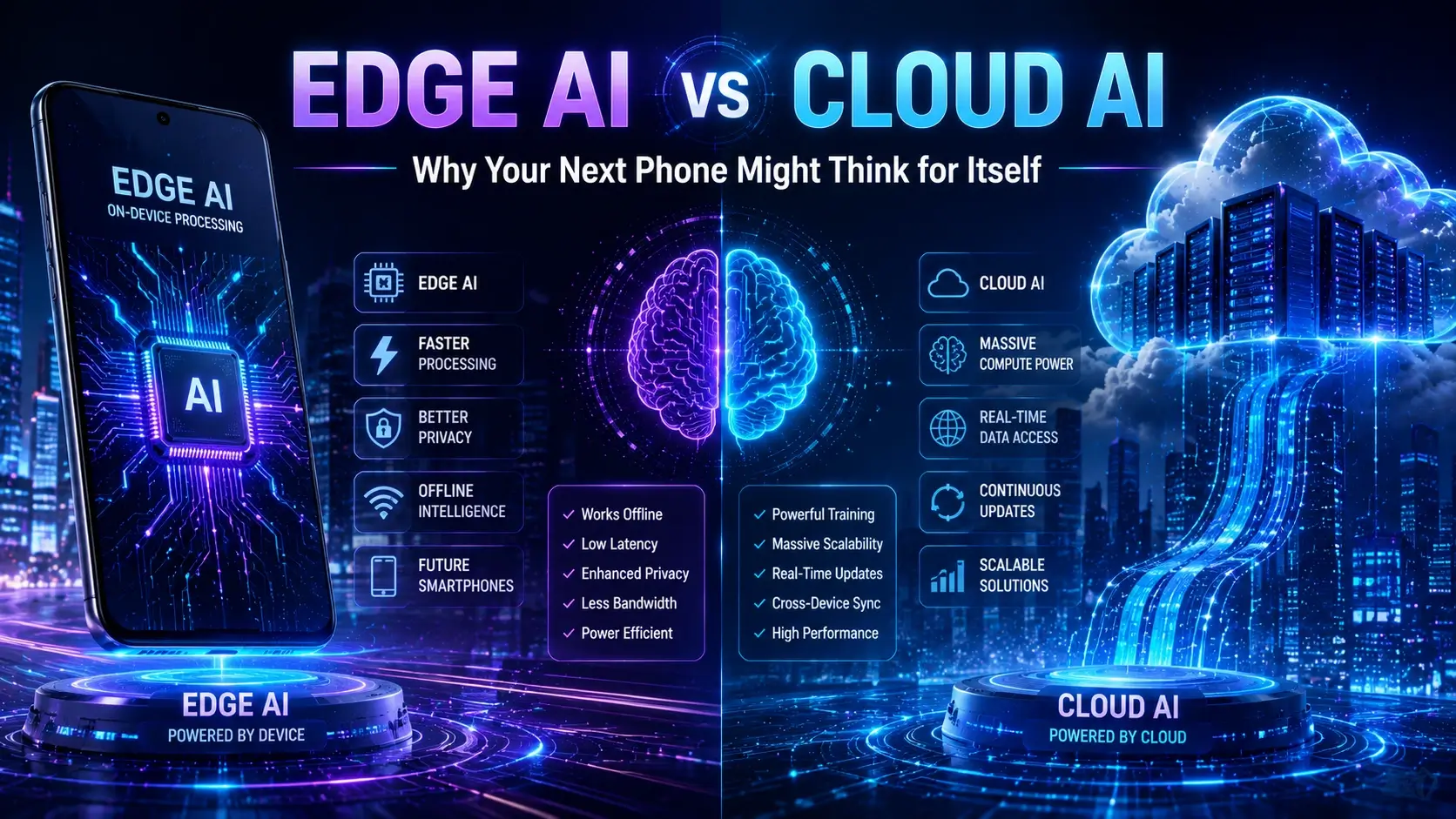
Artificial Intelligence is rapidly changing how smartphones work. Instead of sending every request to cloud servers, modern devices are becoming smart enough to process AI tasks directly on the phone using Edge AI. But does this mean Cloud AI is becoming obsolete? In this guide, we'll explore the differences between Edge AI and Cloud AI, their advantages, real-world use cases, and why the future of smartphones is increasingly powered by on-device intelligence.
Artificial Intelligence has quietly become one of the biggest reasons our smartphones feel smarter every year. Whether it's unlocking your phone with your face, removing unwanted objects from photos, translating conversations in real time, or generating personalized suggestions, AI is working behind the scenes almost constantly.
For years, most AI features relied heavily on cloud computing. Whenever you asked a voice assistant a question or used an AI-powered photo editing tool, your phone would send the data to powerful servers on the internet. These cloud servers would process the information and return the result within seconds.
Today, that approach is changing.
Thanks to faster mobile processors, dedicated Neural Processing Units (NPUs), and improved AI chips, smartphones are becoming capable of running advanced AI models directly on the device. This technology is known as Edge AI, and it's transforming the way we interact with our phones.
What is Cloud AI?
Cloud AI refers to artificial intelligence that runs on remote data centers rather than your local device. Your smartphone captures the information, uploads it securely to cloud servers, and receives the processed response.
For example:
- AI chatbots
- Large language models
- Cloud-based photo enhancement
- Complex image generation
- Advanced translation services
- AI-powered search engines
Cloud AI has enormous computing power because it relies on thousands of GPUs and specialized AI hardware working together. This allows it to run very large AI models that would be impossible for a smartphone to process alone.
However, cloud AI comes with some trade-offs.
It requires a stable internet connection, introduces slight delays while data travels to and from the server, and may raise privacy concerns since user information leaves the device.
What is Edge AI?
Edge AI performs artificial intelligence tasks directly on your smartphone without relying on internet connectivity.
Instead of sending your voice recordings, photos, or personal information to remote servers, the processing happens locally using specialized AI hardware inside your phone.
Modern flagship smartphones now include dedicated AI accelerators capable of handling billions of AI operations every second.
Examples include:
- Face Unlock
- AI camera scene detection
- Background noise removal during calls
- Live captions
- Voice typing
- Offline language translation
- Smart battery optimization
- Photo object removal
- Personalized recommendations
Since everything happens locally, responses are almost instant.
Edge AI vs Cloud AI
| Feature | Edge AI | Cloud AI |
|---|---|---|
| Processing | On the device | Remote servers |
| Internet | Usually not required | Required |
| Speed | Extremely fast | Depends on network |
| Privacy | Better | Data sent to servers |
| Power | Limited by phone hardware | Virtually unlimited |
| Battery | More local processing | Less local processing |
| AI Model Size | Smaller | Much larger |
Why Smartphones Are Moving Toward Edge AI
Several technological breakthroughs have made Edge AI practical.
1. Faster AI Chips
Companies like Apple, Qualcomm, Google, and MediaTek now build processors specifically designed for AI workloads.
These dedicated chips can perform trillions of operations every second while using very little power.
2. Better Privacy
Privacy has become one of the biggest concerns for smartphone users.
When AI processes information directly on the phone, personal data stays on the device instead of being uploaded to cloud servers.
This reduces security risks and gives users greater control over sensitive information.
3. Instant Performance
Nobody enjoys waiting several seconds for an AI feature to respond.
Edge AI eliminates network delays, allowing many AI-powered features to work almost instantly.
This makes voice assistants, camera enhancements, and translation feel much more natural.
4. Offline Intelligence
One of Edge AI's greatest strengths is that many features continue working even without Wi-Fi or mobile data.
Imagine:
- Translating signs while traveling abroad
- Editing photos during a flight
- Live captions during meetings
- Voice typing in remote locations
All of these become possible through on-device AI.
Where Cloud AI Still Wins
Despite Edge AI's advantages, cloud computing remains essential for many AI applications.
Tasks such as generating high-quality images, creating long-form documents, coding assistants, scientific simulations, and advanced reasoning often require massive AI models with hundreds of billions of parameters.
These models simply cannot fit inside today's smartphones.
Cloud AI also receives frequent updates without requiring users to upgrade their devices.
The Best Future: Hybrid AI
Rather than replacing Cloud AI, the future belongs to a hybrid approach.
Your smartphone will intelligently decide where AI tasks should run.
Simple, private, and time-sensitive operations will stay on the device.
More complex requests requiring enormous computing power will automatically move to secure cloud servers.
This combination provides:
- Faster performance
- Better privacy
- Lower latency
- Improved battery life
- Access to powerful AI models
Many modern smartphones are already beginning to use this hybrid strategy.
Real-Life Examples
Imagine asking your phone:
"Remove the stranger from this photo."
The object detection might happen locally using Edge AI, while advanced image reconstruction could be completed in the cloud.
Or imagine saying:
"Translate this conversation."
Basic speech recognition happens instantly on-device, while more advanced language understanding may use cloud AI when internet access is available.
The user experiences seamless AI without worrying where the processing actually happens.
Challenges of Edge AI
Edge AI still faces several limitations.
Large AI models consume significant storage.
Running AI continuously can increase battery usage.
Developers must optimize models to work efficiently on mobile hardware.
Older smartphones may not have powerful enough AI chips to support the latest on-device features.
As hardware improves, many of these limitations will gradually disappear.
What This Means for Consumers
The next generation of smartphones will feel more personal than ever.
Instead of relying entirely on remote servers, your phone will understand your habits, anticipate your needs, protect your privacy, and deliver faster responses.
Whether it's photography, productivity, health tracking, translation, or digital assistants, Edge AI is becoming the intelligence inside your pocket.
Consumers can expect:
- Faster AI features
- Better privacy protection
- Offline AI capabilities
- Longer battery optimization
- More personalized experiences
Final Thoughts
Artificial Intelligence is no longer confined to massive data centers. It's steadily moving into the devices we carry every day. While Cloud AI remains essential for complex tasks requiring enormous computing power, Edge AI is redefining speed, privacy, and convenience by bringing intelligence directly to our smartphones.
The future isn't about choosing one over the other—it's about combining the strengths of both. As mobile processors become more powerful and AI models more efficient, your smartphone will increasingly think, learn, and respond independently. The next generation of devices won't just be connected to intelligence—they'll be intelligent.



Post a comment