

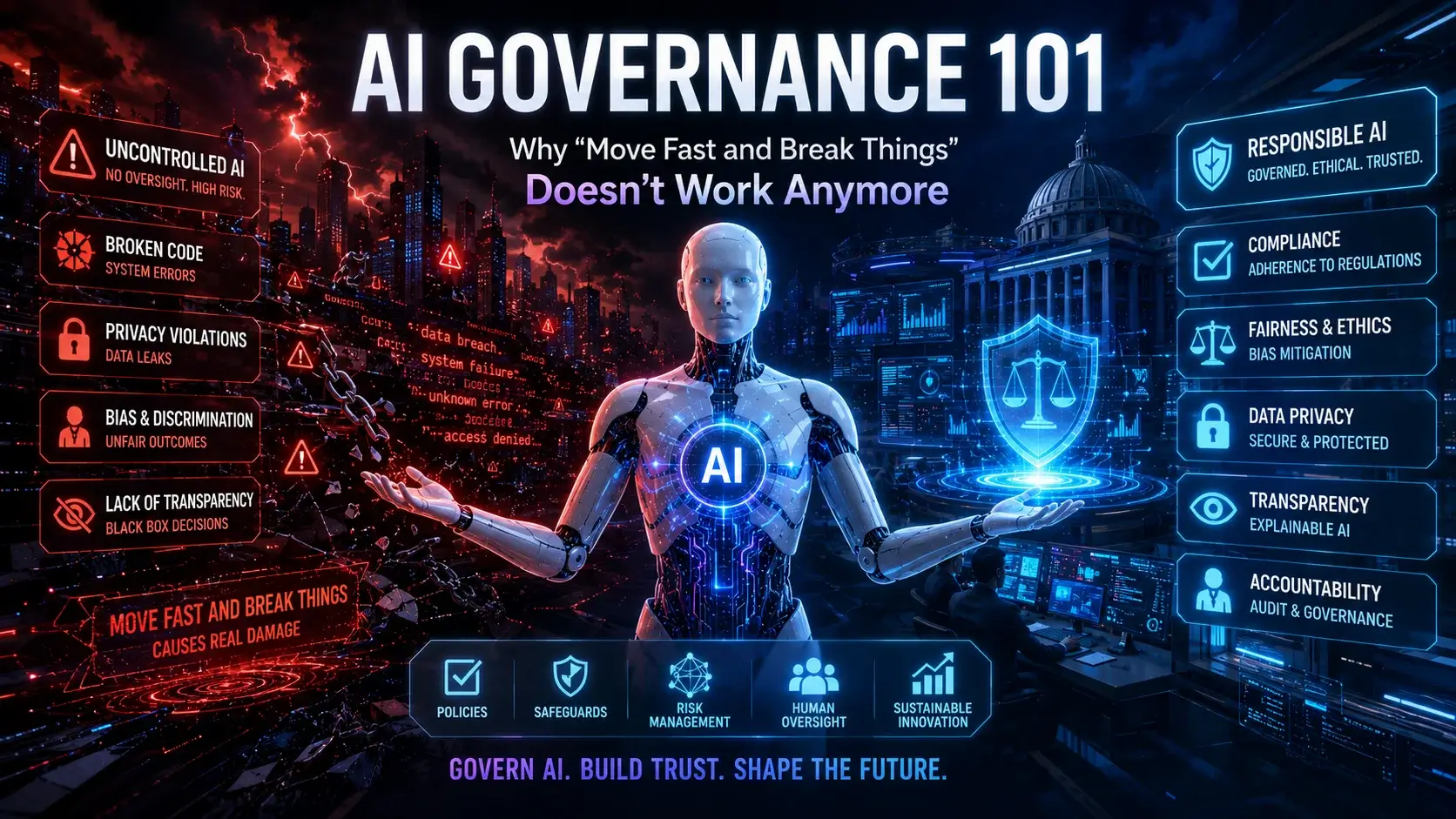
Artificial Intelligence is evolving faster than ever, but speed alone is no longer enough. Businesses, governments, and developers are realizing that AI must be responsible, transparent, and trustworthy. Learn why AI governance has become essential in 2026 and how organizations can innovate without creating unnecessary risks.
AI Governance 101: Why "Move Fast and Break Things" Doesn't Work Anymore
For years, Silicon Valley lived by one famous philosophy: "Move Fast and Break Things." The idea was simple—build products quickly, release them to users, learn from mistakes, and improve along the way.
That approach worked well for social media apps and early internet startups.
But Artificial Intelligence has changed the rules.
Today, AI doesn't just recommend videos or organize photos. It writes code, approves loans, helps doctors diagnose diseases, powers autonomous vehicles, creates content, and even assists governments in making decisions. When AI makes a mistake, the consequences can be far more serious than a software bug.
This is why AI Governance has become one of the biggest technology priorities in 2026.
What is AI Governance?
AI Governance is a collection of policies, standards, processes, and ethical guidelines that ensure Artificial Intelligence systems are developed and used responsibly.
Instead of asking,
"Can we build it?"
Organizations now ask,
"Should we build it?" and "How can we build it safely?"
Good AI governance helps companies create systems that are transparent, fair, secure, and accountable.
It's not about slowing innovation.
It's about making innovation trustworthy.
Why Speed Alone Is No Longer Enough
A few years ago, releasing unfinished software updates wasn't considered a major problem. Developers could simply fix bugs with the next update.
AI is different.
Imagine an AI system rejecting qualified job candidates because it learned biased hiring patterns.
Or an AI medical assistant giving inaccurate health advice.
Or an AI-powered financial system making unfair lending decisions.
These aren't small software glitches—they can affect people's careers, finances, health, and lives.
That's why organizations are investing heavily in governance before deploying AI solutions.
The Biggest AI Risks
Without proper governance, AI systems may create serious challenges.
Bias and Discrimination
AI learns from historical data.
If that data contains bias, AI may unintentionally discriminate against certain groups of people.
Regular testing and monitoring are essential to reduce these risks.
Privacy Concerns
Modern AI models require enormous amounts of data.
Companies must ensure that customer information is collected legally, stored securely, and used responsibly.
Privacy is no longer optional—it's expected.
Lack of Transparency
Many AI models function like a "black box."
Users often don't understand why an AI system made a particular decision.
Explainable AI is becoming increasingly important because people deserve understandable answers.
Security Threats
AI systems themselves can become targets for cyberattacks.
Hackers may attempt to manipulate training data, steal AI models, or generate harmful outputs.
Strong security practices are now part of AI governance.
Legal Compliance
Governments around the world are introducing AI regulations.
Organizations must ensure their AI systems comply with local and international laws to avoid legal and financial risks.
The Core Principles of AI Governance
Successful organizations generally follow several important principles.
Transparency – Users should understand when they are interacting with AI and how important decisions are made.
Accountability – Humans remain responsible for AI decisions. AI should assist people—not replace responsibility.
Fairness – AI should treat users equally without discrimination or hidden bias.
Privacy – Personal information must be protected through secure data handling and clear user consent.
Security – AI systems should be protected against misuse, attacks, and unauthorized access.
Continuous Monitoring – Governance doesn't stop after deployment. AI systems must be regularly tested, updated, and improved.
Why Businesses Should Care
Some organizations still believe governance slows innovation.
In reality, it often speeds up long-term success.
Responsible AI helps businesses:
- Build customer trust
- Reduce legal risks
- Improve product reliability
- Protect brand reputation
- Increase investor confidence
- Meet government regulations
- Prevent expensive AI failures
Customers are more likely to use AI products they trust.
Trust has become one of the most valuable competitive advantages.
AI Governance in Everyday Life
You may already encounter AI governance without realizing it.
Banks review AI lending decisions.
Hospitals validate AI-generated diagnoses.
E-commerce platforms monitor recommendation algorithms for fairness.
Companies audit AI-generated content before publishing.
These practices help ensure AI remains helpful rather than harmful.
The Future of Responsible AI
As AI becomes part of nearly every industry, governance will become just as important as innovation itself.
Future AI systems will likely include built-in monitoring, automated compliance checks, explainable decision-making, and stronger privacy protections.
Businesses that invest in responsible AI today will be better prepared for tomorrow's regulations and customer expectations.
The era of releasing powerful AI without oversight is coming to an end.
Final Thoughts
Artificial Intelligence is transforming the world at an incredible pace. However, the goal is no longer to move as fast as possible—it is to move responsibly.
AI governance isn't about restricting creativity or slowing innovation. It's about ensuring that powerful technologies remain safe, fair, transparent, and beneficial for everyone.
The companies that succeed in the AI era won't necessarily be the ones that build AI the fastest.
They'll be the ones people trust the most.




Post a comment