

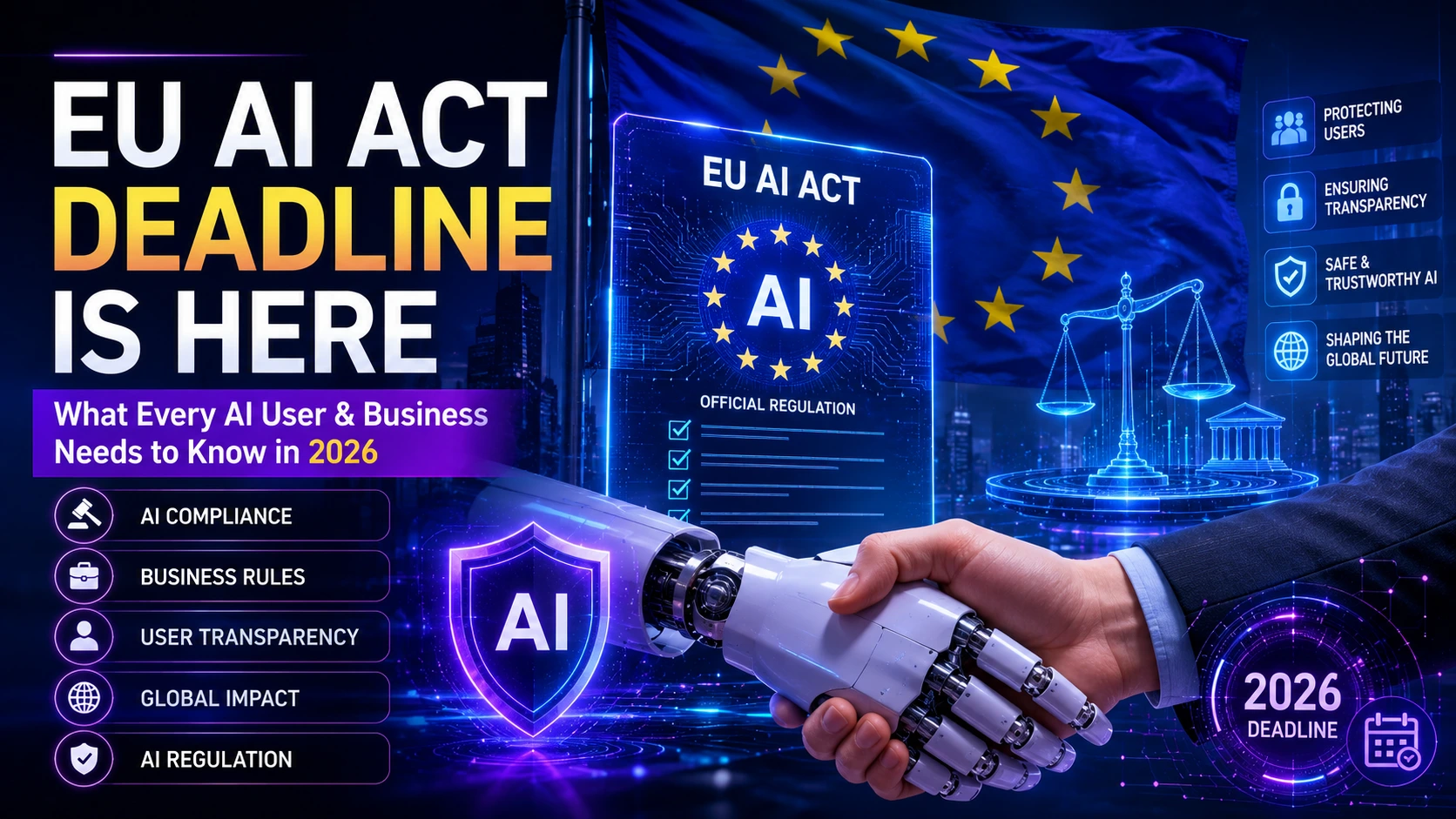
The European Union's AI Act has officially entered a new enforcement phase, bringing stricter rules for artificial intelligence systems across industries. Whether you're an everyday AI user, a startup founder, or an enterprise business, these regulations will influence how AI tools are developed, deployed, and used. Here's everything you need to know about the latest deadline, who it affects, and how businesses can prepare.
EU AI Act Deadline Is Here — What Changes for Users and Businesses
Artificial Intelligence has rapidly become a part of everyday life. From AI-powered chatbots and virtual assistants to healthcare diagnostics, financial services, and autonomous systems, AI is transforming how people work and live. However, as AI capabilities continue to grow, so do concerns about privacy, transparency, safety, discrimination, and accountability.
To address these concerns, the European Union introduced the EU AI Act, the world's first comprehensive legal framework designed specifically to regulate artificial intelligence. With the latest compliance deadline now taking effect, organizations that develop, sell, or use AI systems must begin following stricter requirements.
The impact extends far beyond Europe. Companies around the world—including those in the United States, India, and Asia—may also need to comply if their AI systems serve customers within the European Union.
What is the EU AI Act?
The EU AI Act is a regulation created to ensure AI technologies are safe, transparent, ethical, and respectful of fundamental human rights. Instead of regulating all AI equally, the Act uses a risk-based approach, meaning the stricter the potential risk posed by an AI system, the stricter the legal requirements.
This approach encourages innovation while protecting consumers and businesses from harmful or irresponsible AI practices.
Four Risk Categories

1. Unacceptable Risk
Certain AI applications are completely prohibited because they threaten people's rights or safety. Examples include:
- AI systems designed for harmful manipulation.
- Certain forms of social scoring.
- AI that exploits vulnerable individuals.
These systems are generally banned under the regulation.
2. High-Risk AI
High-risk AI systems are allowed but must meet strict compliance requirements before they can be used.
Examples include:
- Medical diagnosis systems
- Recruitment software
- Credit scoring
- Educational assessments
- Critical infrastructure management
- Law enforcement applications
Businesses using these systems must conduct risk assessments, maintain documentation, ensure human oversight, and continuously monitor performance.
3. Limited Risk
AI tools that interact directly with users must clearly disclose when users are communicating with AI.
Examples include:
- Customer support chatbots
- AI-generated content
- Voice assistants
- Deepfake technologies
Transparency is the primary requirement for these applications.
4. Minimal Risk
Low-risk AI applications such as spam filters, recommendation systems, grammar correction tools, or AI-enabled games generally face minimal regulatory obligations.
What Changes for Businesses?
The latest enforcement deadline means businesses can no longer treat AI governance as an optional future project.
Organizations should now:
- Identify every AI system currently in use.
- Determine the risk category of each AI application.
- Document AI development and decision-making processes.
- Improve transparency regarding AI-generated content.
- Train employees on responsible AI usage.
- Monitor AI systems after deployment.
- Maintain proper compliance records.
- Review contracts with AI vendors and third-party providers.
Companies that prepare early will reduce legal risks while building stronger customer trust.
What Changes for AI Users?
Everyday users can expect several improvements in transparency and accountability.
Users may increasingly notice:
- Clear disclosure when content is AI-generated.
- Notifications when interacting with AI assistants.
- Better explanations for AI-driven decisions.
- Improved protection against harmful or misleading AI systems.
- Stronger safeguards for personal data.
Although users may not immediately notice dramatic differences, AI services will gradually become more transparent and accountable.
Global Impact
Although the legislation originates in Europe, its influence is global.
Many international companies operate across European markets, making compliance essential regardless of headquarters. Similar to the GDPR privacy regulation, the EU AI Act is expected to influence AI regulations worldwide.
Businesses outside Europe that develop AI-powered software, mobile applications, SaaS platforms, or digital services should begin aligning with these standards to remain competitive in international markets.
Why This Matters
Trust has become one of the most valuable assets in the AI era. Organizations that prioritize responsible AI development are more likely to earn customer confidence, attract enterprise clients, and avoid costly regulatory issues.
Rather than viewing the EU AI Act as a barrier to innovation, businesses can see it as an opportunity to build better, safer, and more reliable AI products.
As artificial intelligence becomes increasingly integrated into everyday life, regulations like the EU AI Act will help establish common standards for fairness, transparency, and accountability.
Final Thoughts
The EU AI Act represents a major milestone in the future of artificial intelligence governance. Businesses should use this deadline as a reminder to review their AI systems, improve documentation, strengthen transparency, and invest in responsible AI practices.
For users, the regulation promises safer AI experiences, greater transparency, and stronger protections against misuse.
The AI landscape is evolving quickly, and organizations that adapt early will be better positioned to innovate responsibly while maintaining customer trust and meeting future regulatory expectations.

-1.png)

Post a comment