

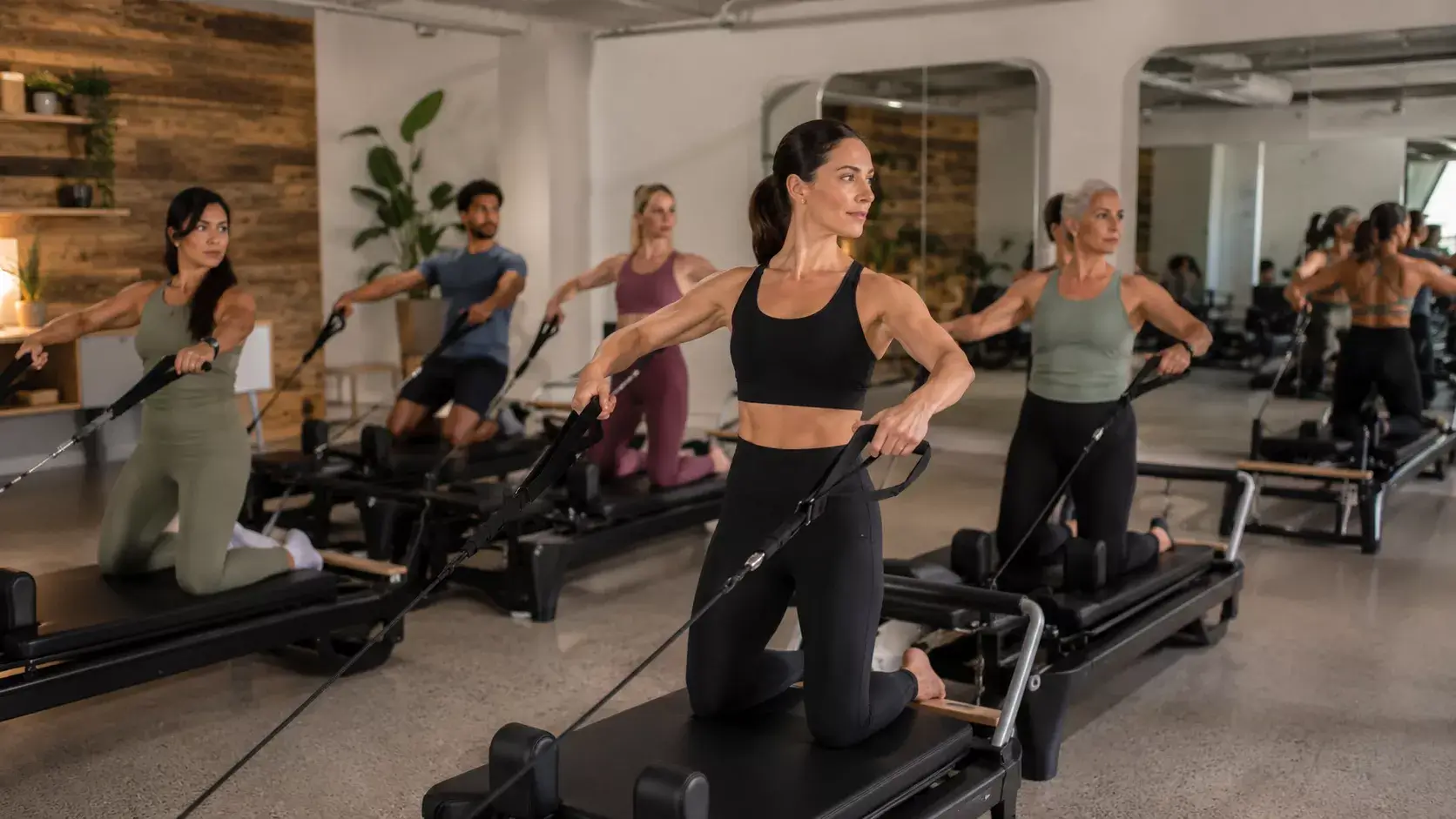
Reformer Pilates has gone from boutique workout to mainstream fitness obsession. Here’s why people are choosing it, what makes the Reformer different, and why the trend shows no signs of slowing down.
The Pilates Boom: Why Reformer Classes Took Over Fitness Culture
Walk into almost any major city these days and there’s a good chance you’ll find a Pilates studio nearby. And inside, you’ll probably see the same thing: rows of sleek machines, people moving slowly and deliberately, instructors counting through controlled exercises, and a waiting list for the next class.
Reformer Pilates has officially become much more than a niche workout.
What was once associated with dancers, rehabilitation and boutique fitness studios has moved firmly into mainstream fitness culture. From social media feeds to luxury gyms and neighborhood studios, the Reformer has become one of the most recognizable pieces of fitness equipment around.
So, what happened?
Why did Pilates suddenly become so popular, and why are people willing to pay more for a workout that often looks slower and less intense than traditional gym training?
The answer is a combination of changing fitness priorities, social media, community, accessibility and the growing desire for workouts that feel challenging without completely exhausting the body.
Pilates Has Changed With the Way We Think About Fitness
For years, fitness culture was heavily focused on intensity.
The message was simple: sweat more, lift heavier, run farther and push harder.
But that mindset has started to change.
More people are now interested in mobility, recovery, posture, strength, longevity and feeling good after a workout — not just burning as many calories as possible.
That shift has created the perfect environment for Pilates.
Pilates focuses on controlled movement, stability, balance, flexibility and muscular endurance. The Reformer adds adjustable spring resistance and a moving platform, allowing exercises to be modified for different ability levels.
That combination makes the workout feel both accessible and demanding.
You may not leave a Reformer class covered in sweat like you would after a high-intensity workout, but your muscles can certainly tell you that they worked.
Industry data reflects how quickly Pilates has grown. Mariana Tek's 2026 Pilates Trends Report found that Pilates was offered by 42% of its tracked North American studios in 2025, while Pilates classes had an average fill rate of 65%, compared with 49% across all modalities.
That tells an important story: people aren't simply trying Pilates once because it is trendy. Many are coming back.
Why the Reformer Became the Star
Pilates can be done without expensive equipment. So why has the Reformer become such a cultural phenomenon?
Part of the answer is that the machine makes the workout feel different from a typical mat class.
The Reformer uses springs, straps, a carriage and other components to create resistance and support. This allows instructors to create hundreds of variations while adjusting the difficulty for different participants.
For beginners, the equipment can provide support and guidance.
For experienced participants, it can make familiar movements significantly more challenging.
That versatility is one reason the Reformer works for such a wide audience.
Someone who has never stepped into a gym can take a beginner class. At the same time, someone who already lifts weights, runs or plays sports can use Pilates as a way to improve control, mobility and muscular endurance.
The format also feels personal. Classes are generally smaller than traditional gym classes, and instructors can pay more attention to technique and movement.
That boutique experience has become a major part of the appeal.
Social Media Helped Turn Pilates Into a Lifestyle
There is another reason Reformer Pilates exploded: it looks good online.
That's not a criticism. It's simply part of modern fitness culture.
Traditional gym workouts can be difficult to capture visually. A person doing a set of squats doesn't necessarily create a completely different image from thousands of other workout posts.
A Reformer studio, however, has a distinctive visual identity.
The machines look modern. Studios often have clean interiors, natural lighting and carefully designed spaces. Matching workout clothes, water bottles, playlists and post-class routines have all become part of the experience.
Social media transformed Pilates from something you do into something that can become part of your lifestyle.
That has been particularly powerful among younger consumers. Mariana Tek's 2026 data found that 43% of Pilates customers in its dataset were Gen Z, while the average Pilates customer was younger than the average customer across all fitness modalities.
In other words, Pilates isn't just attracting people who are already fitness enthusiasts. It is introducing a new generation to boutique fitness.
It's Not Just About Looking Fit
One of the biggest changes in fitness culture is the move away from purely aesthetic goals.
People still care about how they look, of course. But many now want their workouts to improve how they move and feel as well.
Pilates fits neatly into that mindset.
The emphasis on controlled movement, core strength, balance and mobility makes it appealing to people who don't necessarily want another punishing workout.
It also fits nicely into busy lifestyles.
A 45- or 50-minute class can feel structured and complete. You show up, follow the instructor, work through the session and leave.
There's less need to figure out which machines to use or design your own workout.
That convenience matters.
The modern fitness consumer doesn't always want more choices. Sometimes they want someone to tell them exactly what to do for the next 45 minutes.
The Community Factor Is Bigger Than It Looks
There's another piece of the Pilates boom that is easy to overlook: community.
A good Pilates studio isn't simply a room full of exercise equipment.
People recognize the instructors. They see the same faces each week. They book classes with friends. They develop routines around particular studios and time slots.
That creates a sense of belonging.
And community can be one of the strongest reasons people continue exercising.
Recent industry data supports the idea that Pilates customers can become highly engaged once they move beyond the first few visits. ABC Fitness data cited by The Pilates Journal showed a 4.3% increase in Pilates check-ins and a 9% decline in cancellations in late 2025, even as new joins declined.
That suggests the story isn't simply about attracting new customers. Pilates is also creating loyal ones.
Why People Are Willing to Pay More
Let's address the obvious question: why does Reformer Pilates often cost more than a regular gym class?
The equipment is expensive. Studios require specialized machines, maintenance and trained instructors. Class sizes are also limited by the number of Reformers available.
But consumers are paying for more than equipment.
They're paying for an experience.
A boutique studio offers a scheduled class, an instructor, a carefully designed environment and a sense of community. For many people, that feels very different from paying for a large gym membership and working out alone.
Mariana Tek's 2026 report found that Pilates memberships were, on average, 48% more expensive than memberships for other modalities in its dataset, while Pilates classes averaged 25% more than non-Pilates classes.
Yet demand remains strong.
That tells us something important about where fitness spending is going. Consumers aren't necessarily looking for the cheapest workout. They are increasingly willing to spend money on experiences they enjoy and are likely to stick with.
Reformer Pilates Is Moving Into Mainstream Gyms
Perhaps the clearest sign that Pilates has crossed into mainstream fitness culture is the growing interest from large fitness operators.
Reformer Pilates is no longer limited to independent boutique studios.
Major fitness companies are introducing Reformer-based programs to make the format available to a much wider audience. In July 2026, Les Mills announced its new LES MILLS REFORMER program, designed specifically to help mainstream fitness clubs offer Reformer training at scale.
Life Time has also continued expanding its Pilates offering, reporting strong participation and planning Pilates studios in new locations.
That's a significant development.
When large gym chains start investing heavily in a fitness format, it usually means they believe consumer demand is more than a short-lived social media trend.
The Workout Is Evolving, Too
The Reformer isn't staying exactly the same.
A new generation of classes is blending Pilates principles with strength training, athletic conditioning and faster-paced group workouts.
Some studios are experimenting with more intense formats designed for people who want the control of Pilates but also want a stronger cardiovascular and muscular challenge.
This reflects a larger trend in fitness: people don't necessarily want to choose between strength, mobility and recovery.
They want all three.
That's why hybrid workouts are becoming increasingly popular.
The Reformer can be used as the foundation for a traditional Pilates session, but it can also become part of a more athletic workout.
The important distinction is that not every Reformer-based class is traditional Pilates. Some newer formats use the equipment while taking a more fitness-oriented approach.
For consumers, understanding that difference can help them choose the experience they actually want.
Is the Pilates Boom Just a Trend?
Every fitness generation has its obsession.
There was aerobics. Then spinning. Then boot camps, CrossFit, HIIT and boutique cycling.
So it's fair to ask whether Reformer Pilates will eventually disappear from the spotlight.
It probably will become less novel.
But that doesn't necessarily mean it will disappear.
The fundamentals behind its popularity are bigger than social media. People are looking for low-impact exercise, strength, mobility, community and sustainable routines. Pilates checks many of those boxes.
The Sports & Fitness Industry Association's 2026 research also points to continued growth in yoga and Pilates, driven by interest in recovery, longevity, mobility and holistic wellness.
The hype may eventually cool down. That's normal.
But Pilates itself looks increasingly established.
What Comes Next for Reformer Pilates?
The next phase could be less about making Pilates fashionable and more about making it accessible.
Expect to see more Reformers inside traditional gyms, more strength-focused classes, more technology and more options for beginners.
At-home Pilates is also expanding, with consumers increasingly able to access instructor-led workouts without visiting a studio.
At the same time, experienced Pilates customers may start looking for something deeper than the trendy studio experience. As the category becomes crowded, knowledgeable instructors, quality programming and authentic Pilates principles could become bigger differentiators.
In other words, the future of Pilates may involve both innovation and a return to its roots.
The Real Reason Pilates Took Over
The Reformer didn't become popular simply because celebrities posted about it or because the machines look great on Instagram.
Those things certainly helped.
But the bigger reason is that Pilates arrived at exactly the right moment.
Fitness culture is changing.
People are becoming more interested in sustainable exercise rather than constantly pushing themselves to exhaustion. They want workouts that challenge them while still supporting mobility, recovery and long-term health. They want community, structure and an experience they actually enjoy.
Reformer Pilates happens to deliver many of those things in one package.
That's why the Pilates boom feels different from a typical fitness fad.
The hype may eventually fade. The social media aesthetic may change. New workout trends will inevitably arrive.
But the Reformer is unlikely to disappear.
It has already moved from the boutique studio into mainstream fitness culture — and for millions of people, Pilates isn't just the workout they're trying this month.
It's becoming the workout they keep coming back to.



Post a comment