

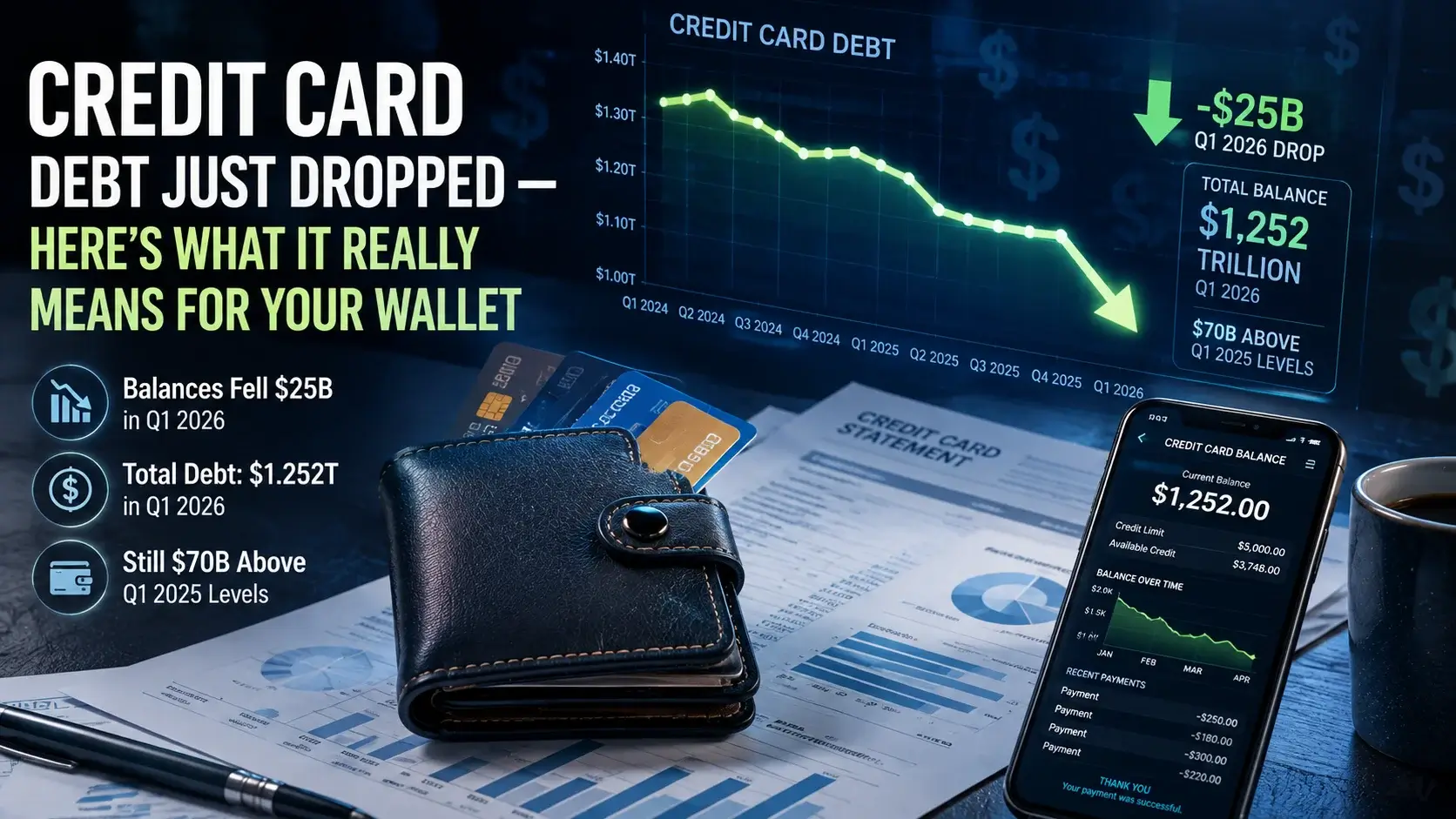
U.S. credit card balances recently fell by $25 billion, but does that mean consumers are finally getting their finances under control? Here's what the drop really means for your wallet, interest payments, credit score, spending habits, and financial future.
Credit Card Debt Just Dropped — Here's What It Really Means for Your Wallet
Seeing credit card debt fall sounds like good news—and in many ways, it is.
According to the Federal Reserve Bank of New York, U.S. credit card balances fell by $25 billion during the first quarter of 2026, bringing total outstanding credit card debt to approximately $1.25 trillion. That is a meaningful quarterly decline.
But there's an important detail hiding behind the headline: credit card balances were still about $70 billion higher than they were a year earlier.
So, should you celebrate? Yes—but maybe not too quickly.
The recent decline gives us an interesting look at how households are managing their money. More importantly, it raises a bigger question: What does falling credit card debt actually mean for your wallet?
A $25 Billion Drop Is Good News—But It's Not the Whole Story
At first glance, a $25 billion reduction in credit card balances sounds huge. And it is.
But household debt can move up and down throughout the year. The New York Fed described the first-quarter decline in credit card balances as a seasonal decrease. At the same time, total U.S. household debt actually increased slightly during the quarter, reaching about $18.8 trillion.
That means consumers haven't suddenly stopped borrowing.
Instead, the data suggests that the financial picture is mixed. Credit card balances came down, while other types of household borrowing—including auto loans and mortgages—continued to increase.
In other words, Americans may be shifting how they borrow rather than simply eliminating debt altogether.
That's an important distinction for anyone trying to understand their own finances.
What Does Falling Credit Card Debt Mean for Your Wallet?
If your personal credit card balance is falling, that's generally a positive sign.
A lower balance can mean:
- Less interest paid over time
- Lower monthly minimum payments
- More available credit
- Lower credit utilization
- More room in your monthly budget
- Less financial stress
- A better opportunity to build savings
The biggest benefit may not be obvious immediately.
When you reduce a credit card balance, you're not just paying down debt. You're also reducing the amount of money that future income has to spend servicing old purchases.
Think about it this way.
If $500 of your monthly income is going toward credit card payments, that money can't simultaneously go toward an emergency fund, investment account, business, education, or other financial goals.
Reducing debt gives your future income more freedom.
Credit Card Interest Is the Real Problem
The balance itself isn't always the biggest issue.
The real financial damage can come from interest.
Credit cards are convenient because they allow you to buy something today and pay for it later. But carrying a balance from month to month can make that convenience expensive.
For example, imagine someone carries a $5,000 balance and makes only minimum payments. Depending on the card's interest rate and payment structure, it could take a long time to eliminate the balance—and the total amount paid could be substantially higher than the original purchases.
That's why paying down high-interest credit card debt can be one of the most powerful financial moves an individual can make.
Every dollar of principal you eliminate is a dollar that no longer generates interest charges.
Your Credit Score Could Benefit Too
Falling credit card balances can also help your credit profile.
One factor commonly considered in credit scoring is credit utilization—the amount of revolving credit you're using compared with your available credit limits.
For example, suppose your credit card limit is $10,000 and your balance is $8,000.
Your utilization is 80%.
If you reduce that balance to $3,000, utilization falls to 30%.
Nothing about your income has changed. You haven't received a raise. You haven't opened a new bank account.
You've simply reduced the amount of credit you're using.
Lower utilization can be helpful for your credit profile, although credit scores are determined by multiple factors and no single action guarantees a particular score increase.
But Don't Assume Everyone Is Doing Better
This is where the headline needs some context.
The decline in credit card balances doesn't automatically mean every household is financially healthier.
Some people may be paying down balances because they're spending less.
Others may be using savings to pay debt.
Some may have transferred balances to another credit product.
And some households may simply be borrowing through other forms of credit instead.
The New York Fed's data shows that while credit card balances declined in Q1 2026, auto loan balances increased by $18 billion and mortgage balances increased by $21 billion.
So the bigger financial picture is more complicated than one number.
The Most Important Number Is Your Number
National debt statistics can tell us what is happening across millions of households, but your personal financial situation matters much more.
Ask yourself four simple questions:
1. How much credit card debt do I have?
Write down every balance. Don't estimate.
2. What interest rate am I paying?
A $2,000 balance at a very high interest rate deserves more attention than a low-interest balance that you are already paying off comfortably.
3. Am I adding new debt every month?
This is one of the most important questions.
If you're paying $500 toward your credit card but adding $600 in new purchases, you're moving backward.
4. What would happen if my income stopped for three months?
This question can reveal whether your biggest problem is debt—or a lack of emergency savings.
Don't Celebrate by Spending Again
One common trap is what could be called the "empty card effect."
You finally pay down a credit card. The available credit increases. Suddenly, the card feels like extra money.
It isn't.
A $5,000 credit limit does not mean you have $5,000 to spend.
It's borrowing capacity.
The healthiest approach is to treat available credit as a financial safety tool rather than an extension of your income.
If your debt is falling, don't immediately replace it with new purchases.
Let the progress compound.
What Should You Do If You Still Have Credit Card Debt?
You don't necessarily need a complicated financial strategy.
Start with a simple plan.
First, stop unnecessary new charges if you're struggling to reduce your balance.
Next, list your cards from highest interest rate to lowest.
Then focus extra payments on the highest-interest debt while continuing to make at least the required payments on the others.
This is commonly known as the debt avalanche strategy.
Another approach is the debt snowball method, where you focus on the smallest balance first to create psychological momentum.
The best method is often the one you can actually stick with.
And if your debt situation feels overwhelming, consider speaking with a qualified financial professional or nonprofit credit counselor before making major financial decisions.
What About Credit Card Rewards?
Rewards can be useful—but only when you're already managing your credit responsibly.
Cash back, travel points, and other rewards can look attractive, but they aren't valuable if you're paying substantial interest on a revolving balance.
A simple rule works well:
Don't pay $10 in interest to earn $1 in rewards.
If you regularly carry a balance, the interest cost can easily outweigh the benefits of rewards.
A Better Goal Than "Having No Debt"
Being debt-free can be an excellent goal, but financial health is bigger than one number.
A stronger long-term target is to build a financial system where:
- You spend less than you earn
- High-interest debt is declining
- Emergency savings are growing
- Credit is used strategically
- Retirement and investment contributions are consistent
- Unexpected expenses don't immediately become credit card debt
That's when falling credit card debt becomes more than a statistic.
It becomes evidence that your financial habits are improving.
The Bottom Line
Yes, the recent decline in U.S. credit card balances is encouraging.
The New York Fed reported that credit card balances fell by $25 billion in the first quarter of 2026 to about $1.25 trillion. Credit card balances also saw a slight improvement in the rate at which borrowers transitioned into early delinquency.
But there is still plenty of work to do.
Credit card balances remain higher than a year earlier, and total household debt continues to sit at historically large levels.
For your wallet, the lesson is simple:
Don't focus only on whether national debt is going up or down. Focus on whether your own debt is moving in the right direction.
If your balance is shrinking, interest charges are falling, and you're avoiding new unnecessary debt, you're making progress.
And if you can take the money that once went toward credit card interest and redirect it toward savings, investments, or other financial goals, that's where the real payoff begins.
A falling credit card balance isn't just a smaller number on a statement.
It can be the beginning of having more control over your money—and more freedom over your future.
Financial information in this article is for educational purposes only and should not be considered personalized financial advice.




Post a comment