

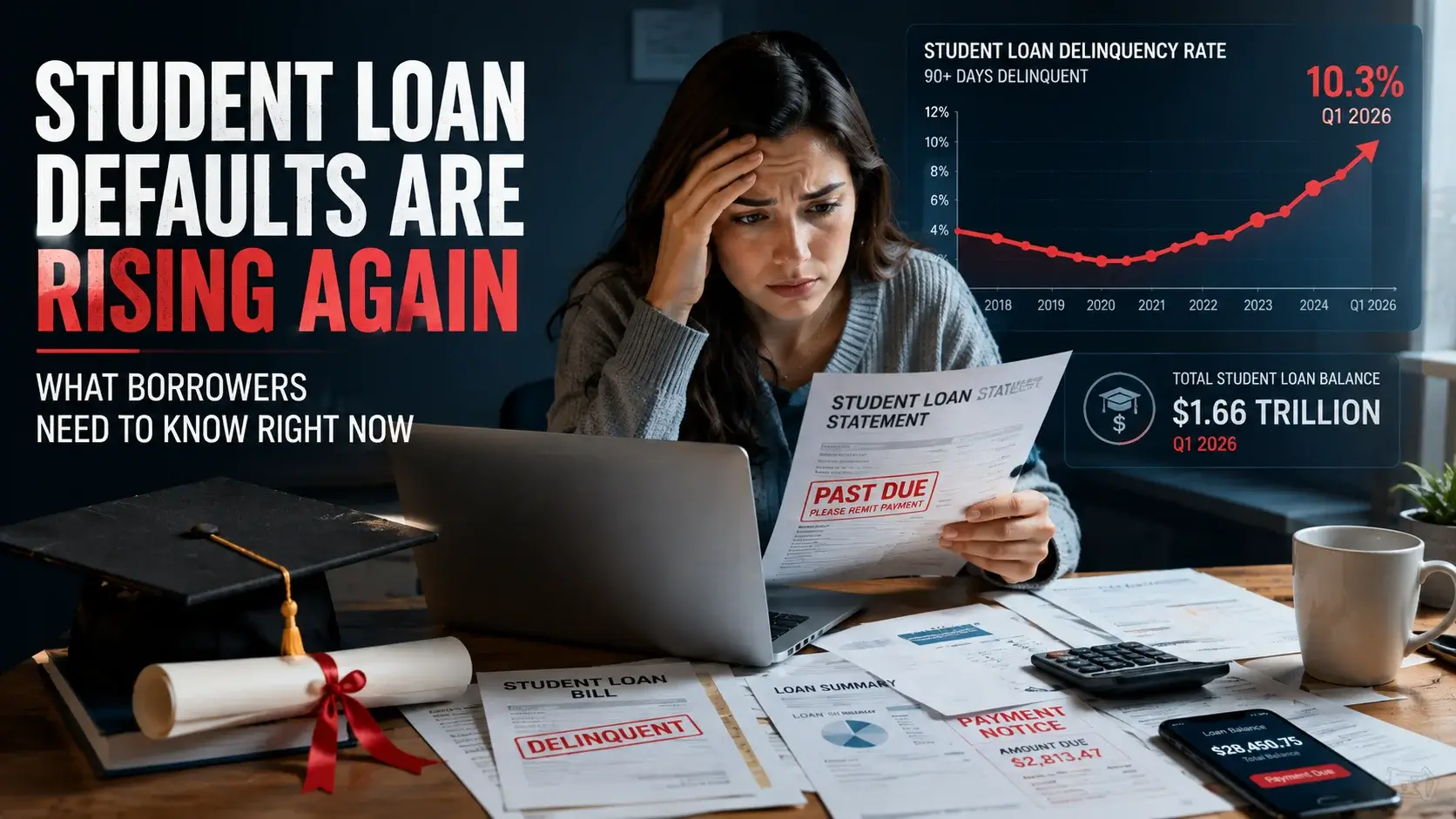
Student loan delinquencies are climbing again as repayment and credit reporting return to normal. Here’s what borrowers should know about missed payments, default, credit damage, collections, and ways to get back on track.
Student Loan Defaults Are Rising Again: What Borrowers Need to Know Right Now
For millions of Americans, student loans have quietly become one of the biggest financial pressures in their lives. After years of pandemic-era payment disruptions and changing repayment rules, borrowers are once again facing regular payments — and the financial consequences of missing them are becoming harder to ignore.
Recent data from the Federal Reserve Bank of New York shows that student loan delinquency remains elevated. At the end of the first quarter of 2026, about 10.3% of outstanding student loan balances were 90 or more days delinquent, up from 9.6% at the end of 2025. Student loan balances stood at roughly $1.66 trillion.
That doesn't mean every borrower who is behind is already in default. But it does show that a significant number of people are struggling to keep up.
And for borrowers who are falling behind, waiting and hoping the problem disappears can make things much more expensive.
Delinquent Doesn't Always Mean Default
One of the most important things borrowers should understand is the difference between delinquency and default.
A federal student loan generally becomes delinquent the day after a scheduled payment is missed. If the account remains delinquent, the loan servicer can eventually report the missed payments to the credit bureaus.
For most federal student loans, default generally occurs after the borrower has failed to make payments for 270 days.
That distinction matters because there may be opportunities to solve the problem before the loan reaches default.
In other words, missing a payment doesn't automatically mean you've lost control of your financial situation. But ignoring the missed payment can allow a manageable problem to become a much bigger one.
Why Are Student Loan Problems Rising Again?
The recent increase is closely connected to the return of normal student loan repayment and credit reporting after the extended pandemic-related pause.
The New York Fed reported that approximately one million borrowers who were more than 120 days past due had their loans transferred to the U.S. Department of Education's Default Resolution Group during the period covered by its 2025 data.
For borrowers who had grown accustomed to having little or no required payment, restarting monthly bills can be a major adjustment.
At the same time, many households are dealing with higher costs for housing, food, insurance, transportation, and other everyday expenses. A student loan payment that once seemed manageable can suddenly become difficult to fit into a monthly budget.
The result is a financial squeeze that can push some borrowers further behind.
What Happens If You Continue Missing Payments?
The consequences can build gradually.
First, your loan becomes delinquent. Continued delinquency can affect your credit history and make it harder to qualify for other forms of borrowing.
If a federal student loan eventually enters default, the consequences can become significantly more serious.
According to Federal Student Aid, borrowers in default may lose access to certain federal student aid benefits and face negative credit reporting. Depending on the situation, the government may also use collection methods such as wage garnishment or Treasury offset. In some circumstances, up to 15% of disposable pay can be withheld through administrative wage garnishment.
That can turn a student loan problem into a broader household-budget problem.
Imagine already struggling to pay rent, groceries, utilities, or a car payment. Having part of your paycheck withheld can make the situation even harder.
Your Credit Score Can Take a Hit
Student loans are part of your overall credit history, so missed payments shouldn't be treated as a minor issue.
Federal Student Aid says delinquent federal student loans can be reported to credit bureaus after extended delinquency, while default can create an additional negative mark on a borrower's credit history.
A damaged credit profile can affect much more than the ability to borrow money.
It can make getting a credit card, auto loan, mortgage, or other financial product more difficult or more expensive. In some cases, credit checks can also affect applications for housing and other services.
That's why dealing with the loan early is generally better than waiting until collection activity begins.
What Should You Do If You Can't Afford Your Payment?
The worst option is usually to simply stop responding.
If your payment is becoming unaffordable, contact your loan servicer as soon as possible. Federal Student Aid recommends borrowers explore available repayment options and contact their servicer if they need help managing payments.
Depending on your circumstances and loan type, possible options may include changing repayment arrangements, requesting temporary relief, or pursuing another eligible solution.
Don't assume that the payment you're currently being billed is the only possible option.
Your income, family circumstances, loan type, and other factors can affect which programs are available to you.
Already in Default? You Still Have Options
Default doesn't necessarily mean the situation is impossible to fix.
Federal Student Aid lists several potential paths for eligible borrowers, including loan consolidation, loan rehabilitation, repayment agreements, or paying the balance in full. The best option depends on the borrower's circumstances and the type of loan involved.
Loan rehabilitation can be particularly important for some borrowers. Under the federal rehabilitation process, eligible borrowers generally make nine on-time voluntary payments within a specified 10-month period. Successful rehabilitation can remove the default status and restore certain federal student aid benefits.
However, borrowers shouldn't automatically choose the first solution they hear about. Each option can have different consequences for interest, credit reporting, collection costs, and future repayment.
Be Careful With Student Loan Scams
Whenever a financial problem affects millions of people, scammers tend to show up.
Be suspicious of companies that promise to "erase" your student debt, guarantee a special government program, or demand large upfront fees simply to help you access federal student loan assistance.
Federal Student Aid specifically warns borrowers to be cautious about companies asking for enrollment, subscription, or maintenance fees to help resolve a federal student loan default.
Before handing over money or personal information, verify that you're dealing with an official organization.
Start with your StudentAid.gov account and your official loan servicer rather than responding to a random text message, social-media advertisement, or unsolicited phone call.
A Simple Checklist for Borrowers
If you're worried about your student loans, don't panic. Start with the basics.
1. Check your current loan status.
Log in to your official federal student aid account and find out whether your loan is current, delinquent, or in default.
2. Know exactly how much you owe.
Look at your principal balance, interest, monthly payment, and loan type.
3. Review your income and expenses.
Create a realistic monthly budget. Knowing what you can actually afford is more useful than guessing.
4. Contact your loan servicer.
Ask about repayment options if your current payment isn't manageable.
5. Don't ignore official notices.
Letters and notifications about delinquency or default can contain important deadlines.
6. Watch for scams.
Never assume a company offering quick debt relief is legitimate.
7. Act before the situation gets worse.
The earlier you address a missed payment, the more options you may have.
The Bigger Lesson
The latest student loan numbers are a warning, but they don't mean every borrower is headed for financial disaster.
For many people, the biggest mistake is not missing one payment. It's ignoring the problem afterward.
Student loan repayment can be complicated, especially when rules, repayment programs, and individual circumstances vary. But borrowers have more power when they know exactly where they stand and take action early.
If you're struggling right now, don't wait for the loan to reach default before asking for help.
Check your account. Understand your options. Contact your servicer. And make decisions based on your actual financial situation rather than fear or pressure.
The goal isn't simply to make the next payment.
It's to create a repayment plan that you can realistically maintain without putting your entire financial future at risk.
This article is for general educational purposes and is not personal financial advice. Student loan rules and repayment options can change, so borrowers should verify their current situation through official federal sources and their loan servicer.




Post a comment