

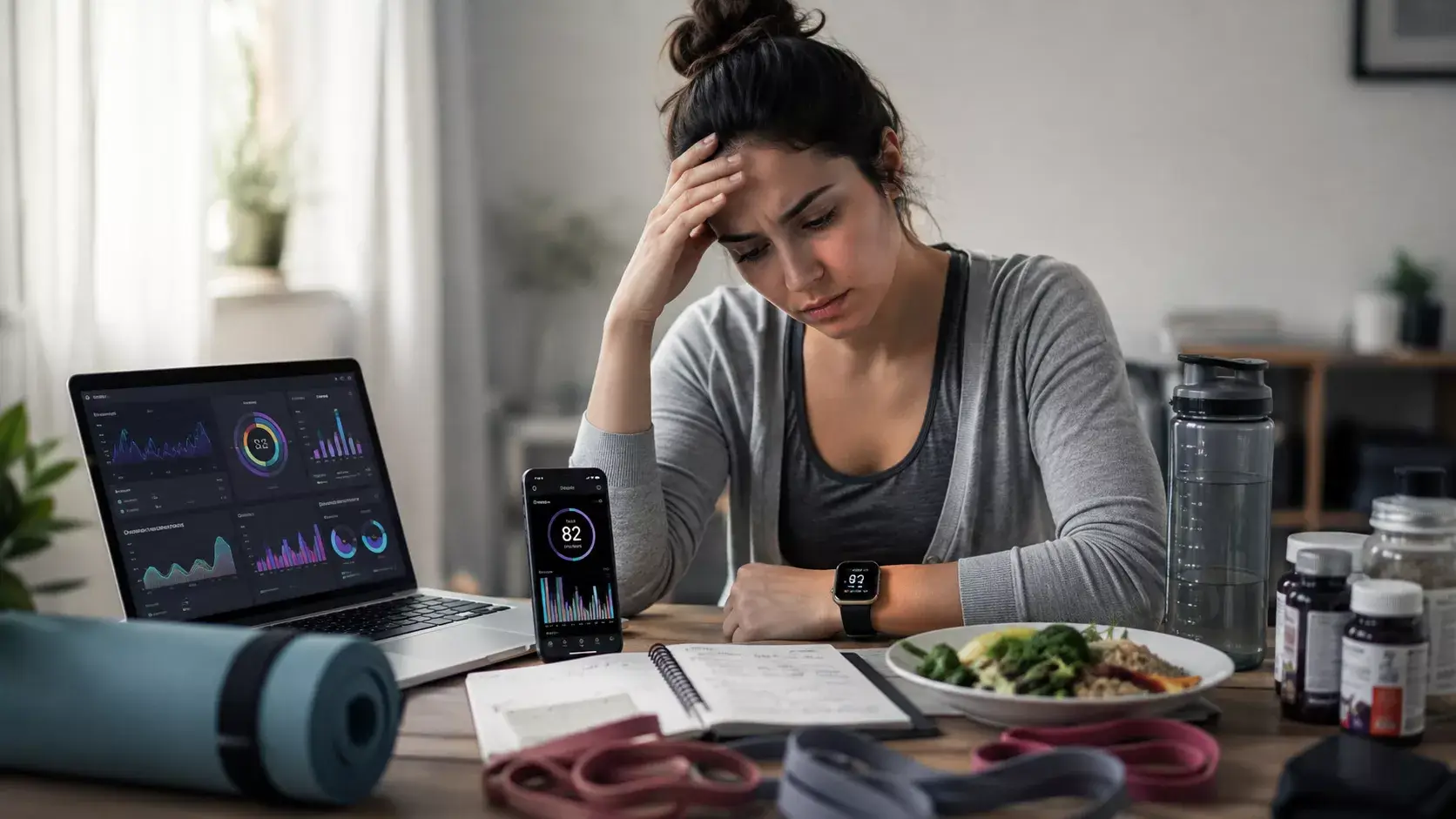
Wellness was supposed to help us feel better. But when every meal, workout, sleep cycle, supplement, and daily habit becomes something to optimize, healthy living can start feeling like another full-time job. Here's why "over-optimization burnout" is becoming a problem—and how to step back without giving up on your health.
There was a time when taking care of your health meant fairly simple things: eat reasonably well, move your body, get enough sleep, drink water, and take a break when you needed one.
Now, wellness can feel like a completely different world.
You can track your sleep score, count your steps, monitor your heart rate, measure your recovery, calculate calories, record your workouts, analyze your stress levels, schedule your meals, optimize your morning routine, and compare your progress with thousands of people online.
At first, it sounds empowering. More information should mean better decisions, right?
Not always.
For some people, the pursuit of better health has quietly turned into a never-ending project. There is always another habit to improve, another supplement to research, another workout to try, another metric to increase, or another part of the routine that supposedly needs fixing.
And eventually, the thing that was supposed to reduce stress can become a source of stress itself.
This is where "over-optimization burnout" comes in.
When Wellness Starts Feeling Like Work
The wellness industry has made optimization incredibly appealing. The message is often subtle: If you know enough, track enough, and make enough small improvements, you can build the "perfect" version of your life.
Wake up at the right time.
Get sunlight in the morning.
Exercise for the right amount of time.
Eat the perfect breakfast.
Avoid certain foods.
Take the right supplements.
Get a specific number of steps.
Go to bed at the perfect hour.
Make sure your sleep score is high.
Meditate.
Stretch.
Journal.
Recover.
Repeat.
None of these habits are necessarily bad. In fact, many of them can be useful. The problem begins when every healthy behavior becomes a performance target.
Instead of asking, "Do I feel better?" you may start asking, "Did I hit my target?"
Instead of enjoying a walk, you may worry about whether it counted toward your daily step goal.
Instead of sleeping peacefully, you may wake up wondering why your wearable gave you a lower score than yesterday.
Instead of eating dinner with your family, you may find yourself mentally calculating calories or questioning whether the meal fits your nutrition plan.
Health becomes something you are constantly measuring rather than something you are experiencing.
The Problem With Trying to Do Everything Right
One of the strange things about wellness culture is that it can make people feel like they are failing while doing objectively healthy things.
You worked out—but not as hard as you planned.
You slept eight hours—but your tracker says your recovery was poor.
You ate healthy—but you didn't hit your protein target.
You meditated—but you skipped it three days this week.
You took a rest day—but now you feel guilty about losing momentum.
This creates a dangerous psychological loop.
Goal → tracking → comparison → guilt → more optimization → exhaustion.
The more you chase perfection, the more opportunities you create to feel like you are falling short.
And because there is always another wellness recommendation online, the finish line keeps moving.
There is no final level where you can say, "I've optimized my health. I'm done."
Social Media Makes the Pressure Worse
Social media has changed the way people think about healthy living.
A simple morning routine can become a carefully edited production: cold shower, workout, supplements, green smoothie, meditation, journaling, sunlight, productivity session and a perfectly organized schedule.
The problem isn't that someone has a disciplined routine.
The problem is that viewers can start believing this is what normal life is supposed to look like.
You see someone's best morning, best workout, best meal, and best habits—but not the messy afternoon, stressful meeting, skipped workout, late-night snack, family responsibility, or day when everything went wrong.
Eventually, ordinary healthy behavior can begin to feel inadequate.
You don't just want to be healthy anymore.
You want to be exceptionally healthy.
And that distinction matters.
More Data Doesn't Always Mean More Health
Technology has made health information easier to access than ever.
Fitness watches and health apps can provide useful information about movement, sleep patterns, heart rate, workouts, and other measurements.
But data is only useful when it helps you make better decisions.
If checking your numbers repeatedly makes you anxious, changes your mood, or causes you to ignore how you actually feel, the technology may be creating more noise than value.
A sleep score is not the same thing as feeling rested.
A calorie number doesn't tell the entire story of your relationship with food.
A step count doesn't measure the quality of your movement.
A workout statistic doesn't capture everything your body needs.
Numbers can provide context, but they should not become the final authority over every decision.
The Hidden Cost: Decision Fatigue
Another overlooked problem with over-optimization is decision fatigue.
Imagine starting your day with dozens of health-related decisions:
Should I exercise before breakfast?
What should I eat?
How much protein do I need?
Should I drink coffee?
When should I take my supplements?
Did I get enough sunlight?
Should I walk after eating?
Do I need a recovery session?
Should I stretch before bed?
What does my sleep data say?
When every small decision becomes a health decision, life can become mentally exhausting.
Eventually, you may become tired not because you're doing too little, but because you're thinking about doing the right thing all the time.
That's a very different kind of burnout.
Healthy Habits Should Make Life Better—Not Smaller
The purpose of wellness should ultimately be to help you live your life.
It shouldn't make you afraid of missing a workout.
It shouldn't make you feel guilty about eating a birthday cake.
It shouldn't make you panic because you went to bed thirty minutes later than usual.
It shouldn't turn a vacation into a spreadsheet.
And it shouldn't make you so focused on improving tomorrow that you forget to enjoy today.
A healthier approach is to focus on consistency rather than perfection.
You don't need the perfect workout. You need movement that you can realistically maintain.
You don't need the perfect meal every day. You need a generally balanced approach to eating.
You don't need flawless sleep every night. You need sustainable sleep habits over time.
You don't need to track everything. You need to understand which information actually helps you.
How to Escape Over-Optimization Burnout
The solution isn't to abandon wellness completely.
Instead, simplify it.
Start by identifying the habits that genuinely make you feel better. Keep those.
Then question the rest.
Ask yourself:
"Does this habit improve my life, or does it simply give me another number to chase?"
Try taking occasional breaks from tracking. Put your wearable aside during a weekend. Eat a meal without recording it. Exercise without worrying about performance. Go for a walk without checking your step count.
Pay attention to how you actually feel.
Are you energetic?
Are you sleeping reasonably well?
Do you enjoy your workouts?
Are you eating in a way that feels sustainable?
Do you have enough time for family, friends, hobbies, and rest?
These questions may tell you more about your overall well-being than another dashboard ever could.
The New Wellness Goal: Enough
Perhaps the next wellness trend shouldn't be about doing more.
Maybe it's about learning when enough is enough.
Enough exercise.
Enough tracking.
Enough supplements.
Enough productivity.
Enough self-improvement.
Enough comparison.
There is nothing wrong with wanting to become healthier. But health shouldn't require you to constantly monitor, measure, and correct yourself.
Sometimes the healthiest choice is simply to live.
Take the walk because it feels good.
Eat the meal without analyzing every ingredient.
Sleep without checking your score first thing in the morning.
Take a rest day without guilt.
Spend an afternoon doing absolutely nothing productive.
Laugh with your friends.
Go outside.
Enjoy your family.
And remember that your body isn't a project that needs to be optimized every minute of the day.
Wellness is supposed to support your life—not become your entire life.
The real upgrade may not be finding another habit to add.
It may be learning which habits you can finally stop worrying about.



Post a comment