

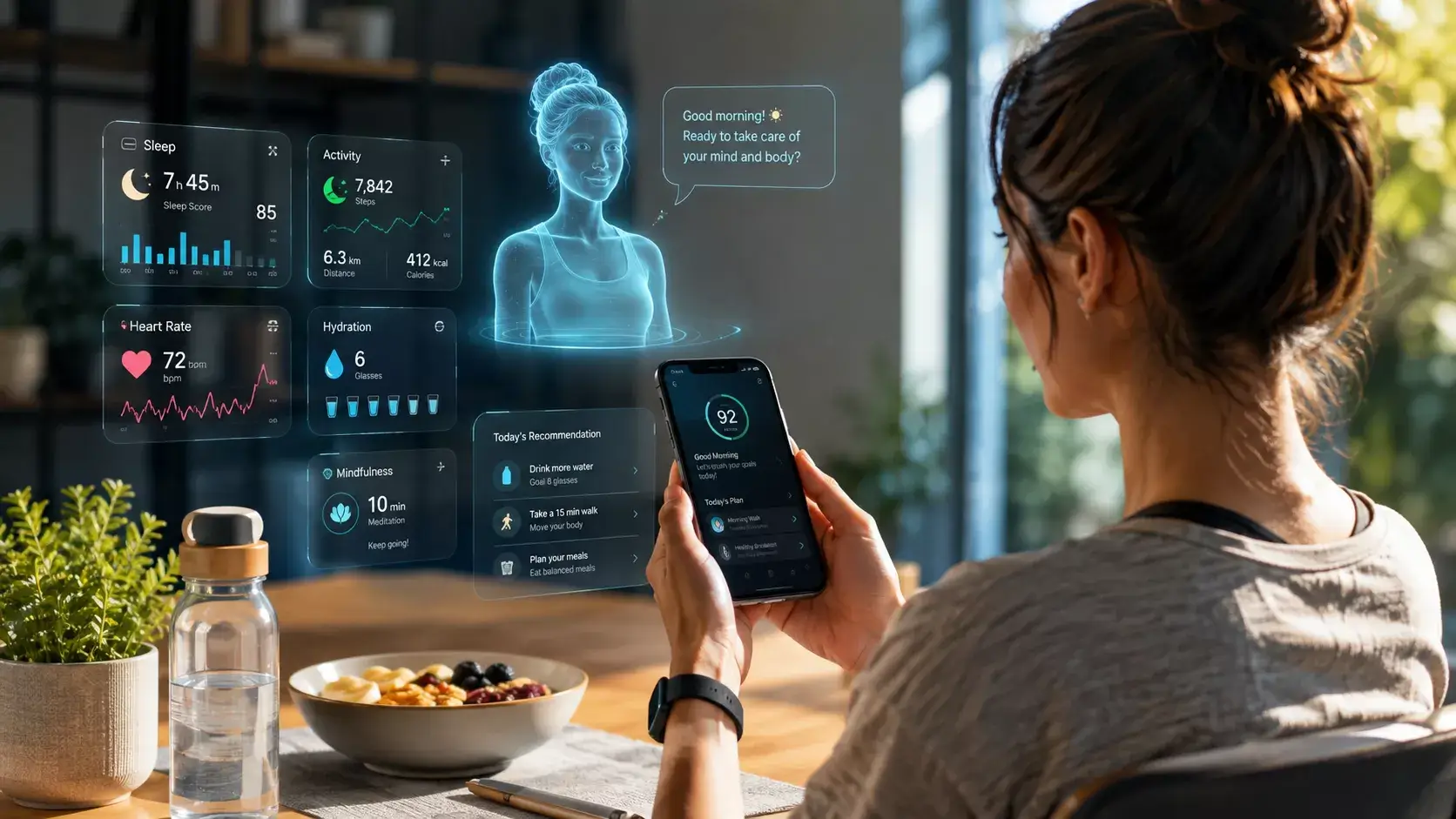
AI wellness coaches are becoming a new way to track habits, improve sleep, manage routines, and stay motivated. But can an algorithm really understand your health, emotions, and everyday struggles?
The Rise of AI Wellness Coaches — Would You Trust One?
Imagine waking up in the morning and your wellness coach is already waiting for you.
It knows how long you slept. It knows whether you exercised yesterday. It may know what you ate, how active you were, and even when your energy levels usually dip. Instead of meeting a human coach, you simply open an app and ask, “What should I do today?”
Within seconds, you get a personalized plan.
Welcome to the growing world of AI wellness coaches.
Artificial intelligence is moving beyond chatbots and productivity tools and finding its way into one of the most personal parts of our lives: our health and daily habits. AI-powered wellness tools can help people build routines, track goals, understand patterns, stay motivated, and make sense of enormous amounts of personal data.
On paper, it sounds incredibly convenient.
But there is a bigger question hiding underneath all that convenience:
Would you actually trust an AI to coach you about your wellbeing?
What Exactly Is an AI Wellness Coach?
An AI wellness coach is essentially a digital system designed to provide personalized guidance around lifestyle and wellbeing.
Depending on the platform, it might help with things such as sleep routines, exercise, nutrition habits, stress management, mindfulness, hydration, productivity, or general healthy living.
Instead of giving exactly the same advice to everyone, AI can use information provided by the user — and sometimes data from connected devices — to make recommendations that feel more personal.
For example, someone might tell an AI coach:
“I've been sleeping badly this week and I feel exhausted.”
A traditional wellness app might simply suggest getting eight hours of sleep.
An AI system could potentially look at the person's recent patterns, ask follow-up questions, notice that bedtime has been inconsistent, and suggest a more realistic routine.
That personalization is one of the biggest reasons AI wellness tools are becoming attractive.
Why Are People Interested in AI Wellness Coaches?
The biggest advantage is simple: availability.
A human wellness coach isn't available 24 hours a day. Appointments need to be scheduled, and professional coaching can be expensive.
An AI coach, on the other hand, can be available whenever someone needs it.
Feeling unmotivated at 11 p.m.? You can open the app.
Need help planning tomorrow's workout? Ask.
Want to build a better morning routine? The AI can help you create one.
This creates a sense of constant accessibility that traditional wellness services often can't provide.
There's also something psychologically appealing about talking to a digital coach. Some people may feel less embarrassed discussing their habits with an AI than with another person.
Admitting, “I've skipped my workouts for three weeks,” can feel uncomfortable when talking to a human.
Typing it into an app may feel much easier.
The Personalization Problem
Personalization sounds great, but it comes with an important limitation.
AI can recognize patterns in data. It can generate recommendations based on information you've provided. But that doesn't necessarily mean it understands you.
There is a difference between recognizing that someone slept five hours and understanding why they slept five hours.
Maybe they have a newborn baby.
Maybe they're working two jobs.
Maybe they're worried about money.
Maybe they're going through a difficult period in their personal life.
A spreadsheet can show the numbers. A person can sometimes understand the story behind them.
That distinction matters.
Wellness isn't just about steps, calories, sleep scores, or workout minutes. Human wellbeing is messy. Motivation changes. Circumstances change. Emotions change.
And sometimes the healthiest decision isn't the one that produces the best number on a dashboard.
When AI Wellness Coaching Can Be Useful
That doesn't mean AI wellness coaches are a bad idea.
In fact, they could be genuinely useful for everyday lifestyle support.
An AI coach can help someone stay accountable to small goals.
Instead of saying:
“I need to completely transform my health.”
It can encourage something much more manageable:
“Let's take a 20-minute walk today.”
That difference can be powerful.
AI can also help identify patterns that humans might overlook. If someone consistently stays up late before stressful workdays, for example, a wellness app may help highlight the pattern.
It can turn vague intentions into practical actions.
Drink more water.
Go for a walk.
Prepare tomorrow's meals.
Create a consistent bedtime.
Take a break from the screen.
None of these ideas are revolutionary. But having a system that reminds you, adapts to your routine, and keeps you accountable can make them easier to follow.
But There Is a Trust Problem
Here's where things get complicated.
The more useful an AI wellness coach becomes, the more personal information it may need.
Think about the data involved.
Sleep patterns.
Exercise habits.
Food choices.
Weight.
Stress levels.
Mood.
Daily routines.
Possibly information from wearable devices.
That's an enormous amount of personal data.
So before asking, “Can AI give me good wellness advice?” we should also ask:
“Who has access to my wellness data?”
Users need to understand how their information is collected, stored, processed, and shared.
Convenience shouldn't mean giving away privacy without thinking about it.
The relationship between people and wellness technology needs transparency. Users should know what the system can do, what it cannot do, and where their information goes.
AI Is Not a Doctor
This may be the most important distinction of all.
An AI wellness coach can potentially help with lifestyle habits, motivation, organization, and general wellness information.
But that doesn't make it a doctor, therapist, dietitian, or other healthcare professional.
A chatbot may produce an answer that sounds confident and convincing while still being wrong or inappropriate for a particular person.
That's why AI-generated wellness advice should be treated as supportive information rather than a replacement for professional medical care.
If someone has persistent symptoms, a serious medical concern, a mental health crisis, or a condition requiring treatment, an AI wellness app should not become the final authority.
Knowing when to stop asking the algorithm and talk to a qualified professional may become one of the most important digital health skills of the AI era.
Could AI Actually Become a Better Coach?
Possibly — but probably not by simply replacing humans.
The more interesting future may be a combination of both.
Imagine an AI system tracking everyday patterns and helping someone stay consistent between appointments, while a qualified professional handles complicated decisions and provides human judgment.
The AI could handle the repetitive stuff.
The human could handle the deeply personal stuff.
That combination makes more sense than expecting an algorithm to solve every aspect of someone's wellbeing.
After all, good coaching isn't only about information.
It's also about empathy, context, encouragement, judgment, and knowing when someone needs a different kind of help.
Would You Trust One?
For everyday habits, many people probably will.
If an AI coach reminds you to stand up, encourages you to walk more, helps organize your meals, or suggests a better bedtime routine, the risks may feel relatively small.
But the closer AI gets to sensitive areas of health and personal decision-making, the more careful we should become.
Would you tell an AI about your anxiety?
Would you share your complete eating history?
Would you trust it to interpret your sleep data?
Would you follow its advice when you aren't feeling well?
And perhaps the most important question:
Would you know when not to trust it?
That may ultimately determine whether AI wellness coaches become genuinely helpful tools or simply another technology that promises more than it can deliver.
The Future of Wellness May Be Hybrid
The rise of AI wellness coaches isn't necessarily about humans versus machines.
It may be about finding the right balance.
AI is exceptionally good at processing information, recognizing patterns, remembering details, and being available on demand.
Humans are better at understanding context, emotions, relationships, uncertainty, and the complicated realities of everyday life.
The smartest approach may be to use AI for what it does well without expecting it to become something it isn't.
Use it as a guide.
Use it for accountability.
Use it to organize information and build healthier routines.
But keep human expertise involved when the situation becomes serious, complicated, or deeply personal.
Because wellness isn't a data problem alone.
It's a human problem.
And no matter how intelligent our technology becomes, that's something worth remembering.
Final Thought
AI wellness coaches could become one of the most interesting developments in personal health and lifestyle technology. They may make personalized guidance more accessible, affordable, and available to more people.
But trust shouldn't be automatic.
The best AI wellness coach isn't necessarily the one that gives you the most advice. It may be the one that knows its limitations, respects your privacy, encourages realistic habits, and recognizes when a human professional should take over.
So, would you trust one?
Maybe the better question is:
How much of your wellbeing are you comfortable putting in the hands of an algorithm?




Post a comment