

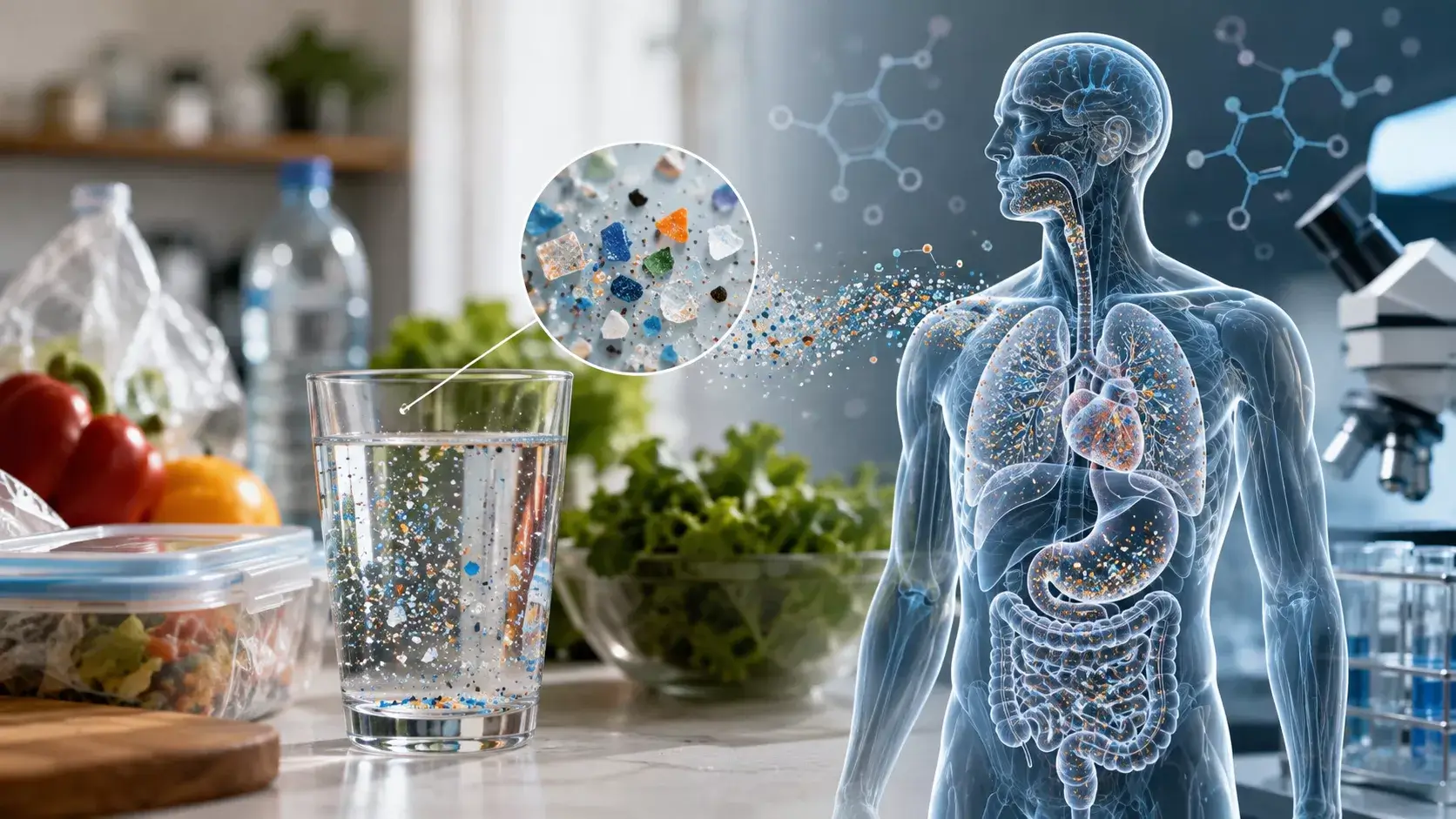
Microplastics are now being detected in food, water, air and human tissues. But what does that actually mean for your health? Here’s what current research shows, what scientists are still trying to understand, and what you can realistically do.
Microplastics and Your Health: What the Science Actually Shows
Plastic has become so deeply woven into everyday life that it is easy to forget how unusual the material really is. It is in our food packaging, water bottles, clothing, furniture, electronics and even the dust inside our homes.
But as plastic products break down, they can release tiny particles known as microplastics. These particles are generally defined as plastic pieces smaller than 5 millimeters, while even smaller particles are often called nanoplastics.
And here is where the story becomes complicated.
Scientists have found microplastics in the environment, in food and water, and in biological samples from humans. That sounds alarming—and it deserves attention. But finding plastic particles inside the human body is not the same thing as proving that they cause a particular disease.
So, what does the science actually show?
We Are Exposed to Microplastics in More Ways Than One
There isn't one single source of microplastic exposure.
We can potentially swallow particles through food and drinking water, breathe particles suspended in the air, and come into contact with them through everyday environments. Research has also shown that indoor air can be an important exposure pathway because synthetic textiles, household materials and other plastic-containing products can shed tiny particles.
Food packaging gets a lot of attention, but it is only part of the picture.
Plastic containers, synthetic clothing, household dust and environmental pollution can all contribute to exposure. This doesn't mean that every piece of plastic is immediately dangerous. It means that our contact with tiny plastic particles is widespread and difficult to completely avoid.
Scientists Have Found Microplastics in the Human Body
One of the biggest developments in recent research is the detection of microplastics and nanoplastics in human biological samples.
Researchers have reported particles in samples including blood, lungs, digestive material and reproductive tissues. A 2024 review highlighted growing evidence that these particles can enter the body and potentially move through different biological systems.
More recent systematic research is beginning to look specifically at evidence from living humans rather than relying primarily on laboratory or animal experiments.
A 2026 systematic review identified 25 studies involving microplastic or nanoplastic measurements in living humans. However, the researchers also emphasized major differences between studies and the difficulty of drawing firm conclusions about long-term health effects.
That distinction matters.
Detection is not the same as disease.
Finding a particle in someone's blood, for example, does not automatically prove that the particle caused an illness.
So, Are Microplastics Actually Harmful?
This is where headlines can sometimes get ahead of the evidence.
Laboratory and experimental studies have identified several biological processes that could potentially be affected by microplastics. Researchers are investigating inflammation, oxidative stress, changes in cellular function, endocrine activity and possible effects on the immune and reproductive systems.
These findings are important because they provide possible biological explanations for how microplastics might affect the body.
But there is a major limitation.
Much of the strongest evidence for specific biological effects still comes from laboratory, animal or experimental research. The concentrations, particle sizes and types of plastic used in experiments may not perfectly represent the exposures experienced by ordinary people.
That means we should be careful about statements such as "microplastics cause cancer" or "microplastics are causing infertility" unless the evidence specifically supports those claims.
At present, scientists are still working to establish how much exposure is harmful, which types of particles matter most, whether effects accumulate over time and which health outcomes are genuinely caused by microplastic exposure.
What About the Heart and Blood?
One area receiving growing attention is cardiovascular health.
A 2024 study examined microplastic particles found in human blood and explored relationships with coagulation and inflammatory markers. Studies like this are interesting because they move the research beyond simply asking whether particles are present and begin investigating whether their presence is associated with measurable biological changes.
However, an association does not automatically establish cause and effect.
Researchers need larger studies, better exposure measurements and long-term follow-up before we can confidently say how microplastics affect cardiovascular disease risk.
What About the Lungs?
Breathing is another important exposure pathway.
Microplastics have been detected in human respiratory samples, and researchers are investigating whether long-term inhalation could contribute to respiratory inflammation or other problems. Recent reviews have identified possible links with respiratory health outcomes, while also pointing out that real-world exposure levels remain difficult to measure accurately.
This is particularly relevant because indoor environments can contain plastic fibers and particles released from clothing, furniture and other materials.
Still, scientists are not yet able to give everyone a simple answer such as "a certain amount of airborne microplastic will cause lung disease." The evidence isn't that precise yet.
What Does the World Health Organization Say?
The World Health Organization has reviewed exposure to microplastics through food, water and air and has repeatedly emphasized the significant gaps in current knowledge.
Its assessment makes an important point: researchers need better information about exposure levels, particle characteristics and potential health effects before the risks can be fully understood.
In other words, the scientific message is neither "microplastics are completely harmless" nor "every plastic particle is poisoning you."
The more accurate message is:
Microplastic exposure is widespread, biological effects are plausible and increasingly studied, but the full consequences for human health are not yet known.
Should You Be Worried?
Probably not in the sense of living in fear of every plastic bottle or food container.
There is currently no practical way for most people to eliminate microplastic exposure completely. And trying to do so can quickly become overwhelming.
Instead, think about reducing unnecessary exposure where it is easy and reasonable.
For example, you might:
-
Avoid unnecessarily heating food in plastic containers.
-
Use glass or stainless-steel containers when convenient.
-
Reduce reliance on heavily packaged foods.
-
Keep indoor spaces clean and reduce accumulated household dust.
-
Follow local guidance on drinking-water quality and filtration.
-
Avoid unnecessary single-use plastics when practical.
-
Wash hands before eating, especially after handling dusty or plastic-heavy environments.
-
Choose reusable products that are durable rather than constantly replacing disposable ones.
These are sensible environmental and household habits, but they should not be presented as proven medical treatments for microplastic exposure.
The Bigger Picture
Perhaps the most important lesson from microplastic research is not that we should panic about invisible particles.
It is that modern science is still discovering the consequences of living in a world surrounded by synthetic materials.
Researchers now have evidence that microplastics can enter the human body, and studies are investigating potential biological effects. At the same time, major uncertainties remain around dose, long-term exposure, particle type, individual susceptibility and actual disease risk.
That uncertainty is frustrating, especially when social media offers simple answers.
But uncertainty is not the same as ignorance.
It means the research is developing.
The smartest approach right now is to take the issue seriously without turning it into another wellness fear cycle. Reduce unnecessary plastic exposure where practical, support better environmental practices, and pay attention to high-quality research rather than dramatic headlines.
Microplastics may ultimately turn out to be an important environmental health problem—or scientists may discover that some particles and exposure levels matter much more than others.
We simply do not have the complete answer yet.
And honestly, "we're still finding out" is sometimes the most scientifically responsible answer we can give.



Post a comment