

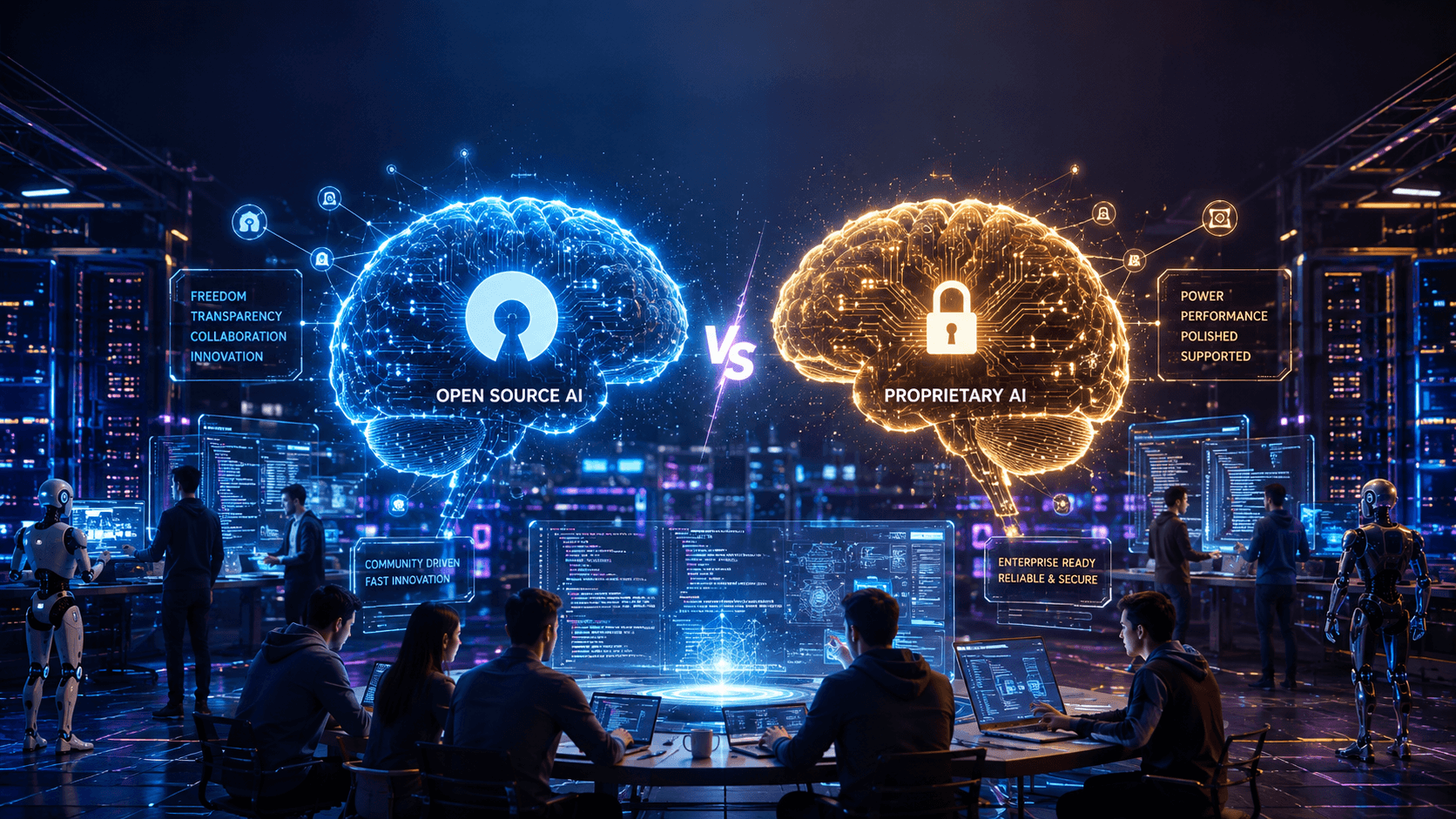
Open-source AI models are evolving at an incredible pace, narrowing the gap with proprietary systems from major tech companies. But what does this mean for businesses, developers, and everyday users? Here's why the rise of open-source AI matters more than ever in 2026.
Artificial Intelligence is no longer controlled by just a handful of technology giants. Over the last few years, open-source AI models have improved at an astonishing speed, giving developers, startups, and businesses access to powerful AI without paying premium subscription fees or depending entirely on closed ecosystems.
In 2026, the gap between open-source and proprietary AI has become much smaller than many people expected. Models released by research communities and technology companies are now capable of generating text, writing code, creating images, analyzing documents, and even running autonomous AI agents. While commercial AI models still lead in some advanced benchmarks, the difference in everyday practical use is becoming increasingly difficult to notice.
So, should you care? The short answer is yes.
One of the biggest advantages of open-source AI is freedom. Developers can customize models for their own needs, host them on private servers, fine-tune them using industry-specific data, and integrate them into products without relying entirely on external providers. This flexibility is especially valuable for companies dealing with sensitive information, healthcare records, financial data, or government projects where privacy is critical.
Another major benefit is cost efficiency. Instead of paying recurring subscription fees for every AI request, organizations can deploy open-source models on their own infrastructure. As hardware becomes more affordable and AI optimization improves, running local AI is becoming a realistic option even for small businesses.
Innovation is another reason why open-source AI is growing rapidly. Thousands of developers around the world contribute improvements, fix bugs, publish research, and create specialized versions for different industries. This collaborative ecosystem accelerates progress in ways that closed development often cannot match.
However, open-source AI isn't perfect. Running powerful models locally requires technical expertise, computing resources, and ongoing maintenance. Commercial AI providers still offer better customer support, seamless updates, stronger safety systems, and highly polished user experiences. For organizations without dedicated AI teams, managed AI services can still be the simpler choice.
Rather than replacing proprietary AI, open-source models are expanding the possibilities. Many businesses now use a hybrid approach—leveraging commercial AI for complex reasoning tasks while deploying open-source models for internal automation, customer support, coding assistance, and private workflows.
The rapid growth of open-source AI is also creating new opportunities for entrepreneurs. Startups can build AI-powered applications without enormous infrastructure costs, developers can launch innovative products faster, and researchers can experiment freely without restrictive licensing. This democratization of AI is driving competition, encouraging transparency, and making advanced technology accessible to more people than ever before.
Looking ahead, the future of AI is unlikely to belong to a single company or platform. Instead, we'll probably see an ecosystem where open-source and proprietary AI continue to coexist, each serving different needs. Businesses that understand both options will be better positioned to innovate while controlling costs and protecting data.
Whether you're a developer, entrepreneur, student, or simply someone curious about technology, keeping an eye on open-source AI is worthwhile. The tools are becoming more capable every month, and they are changing how software is built, how businesses operate, and how people interact with artificial intelligence. The question is no longer whether open-source AI can compete—it’s how quickly it will reshape the AI landscape.


Post a comment