

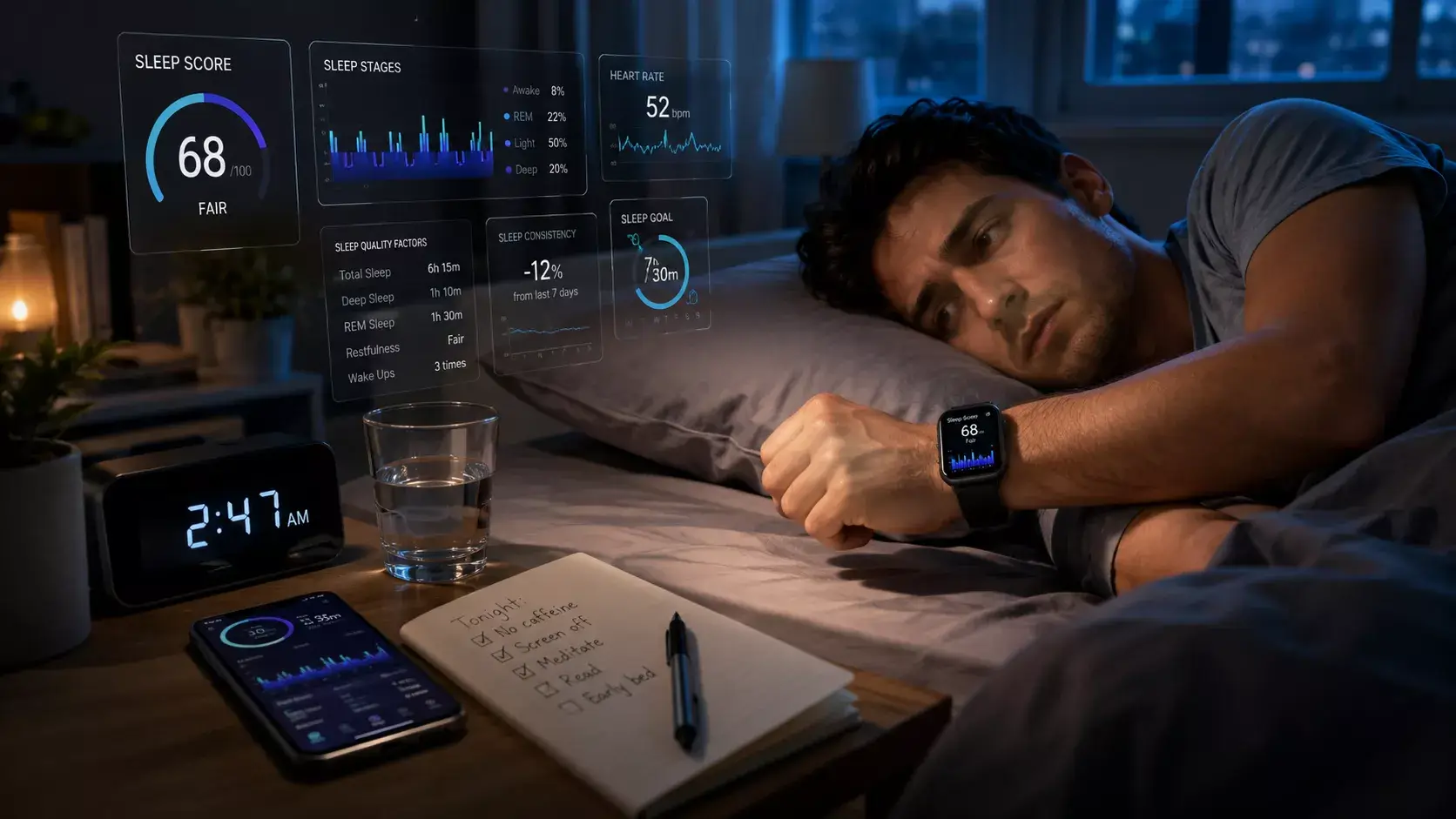
Sleep trackers, perfect bedtime routines, recovery scores, and strict sleep goals promise better health. But when getting “perfect sleep” becomes another daily performance target, could the obsession itself be keeping us awake?
The Sleep Optimization Obsession: Is It Actually Making Us Healthier?
Sleep has officially become something we can measure, score, track, and optimize.
Open almost any health or fitness app today and you may find a sleep score waiting for you in the morning. You can see how long you slept, how many times you woke up, how much deep sleep you supposedly got, your heart rate, your recovery level, and sometimes even a recommendation for what time you should go to bed.
On paper, this sounds like progress.
After all, sleep is one of the foundations of good health. Adults are generally advised to get at least seven hours of sleep regularly, and consistently getting too little sleep is associated with a range of health and performance problems.
But there is a strange twist emerging in our increasingly data-driven approach to wellness: What happens when trying to sleep better becomes another thing we stress about?
When Sleep Becomes a Performance Goal
There is nothing wrong with wanting better sleep.
Going to bed at a reasonable time, maintaining a consistent schedule, reducing late-night distractions, and creating a comfortable bedroom can all be sensible habits. The problem starts when healthy habits turn into rigid rules.
Maybe you went to bed at 10:00 p.m. because your tracker said that was your ideal bedtime. You woke up at 7:00 a.m., but your sleep score was only 72.
Suddenly, you start wondering what went wrong.
Was your deep sleep too low? Did you wake up too many times? Was your heart rate slightly higher than yesterday? Did you drink coffee too late? Was your bedroom temperature two degrees too warm?
Instead of simply waking up and getting on with your day, you begin analyzing the night.
This is where sleep optimization can become counterproductive.
Researchers and clinicians have used the term “orthosomnia” to describe an unhealthy preoccupation with achieving supposedly perfect sleep, particularly when people become overly focused on data from sleep-tracking devices. Research has linked this kind of preoccupation with anxiety, rigid sleep behaviors, and potentially worsening sleep problems.
The irony is obvious: you are trying so hard to sleep perfectly that you may become too worried about sleeping.
More Data Doesn't Always Mean Better Sleep
Wearable technology has made sleep data incredibly accessible.
Smartwatches and fitness trackers can provide useful estimates and help people notice patterns. For example, someone might discover that they consistently sleep less after late-night work or that their bedtime changes dramatically on weekends.
That information can be helpful.
But there is an important distinction between using data as a guide and treating data as a verdict.
Consumer sleep trackers are not the same as clinical sleep testing. They estimate sleep-related measures using sensors and algorithms, and their numbers should not automatically be treated as a precise measurement of everything happening in your brain and body during the night.
In other words, a sleep score of 68 does not necessarily mean you had a “bad” night.
And a score of 94 does not automatically mean you had a perfect one.
Interestingly, research involving people with insomnia has not shown that simply wearing a sleep tracker inevitably makes sleep worries worse. This suggests the issue isn't the technology itself; rather, it may depend on how people interpret and respond to the information.
That distinction matters.
The Seven-Hour Rule Isn't a Competition
One of the most common sleep-optimization mistakes is turning recommendations into rigid targets.
For adults, major sleep organizations recommend at least seven hours of sleep regularly for healthy adults, while individual sleep needs can vary. Sleep health is also about quality, timing, regularity, and whether sleep is disrupted by an underlying problem.
So getting seven hours and 58 minutes instead of eight hours doesn't mean you've failed.
Sleeping eight hours and waking up feeling refreshed isn't automatically better than sleeping seven and a half hours.
And spending an extra hour in bed simply because your app says you need it isn't necessarily the answer.
The goal should be adequate, restorative sleep, not winning a nightly competition against your previous sleep score.
The Bigger Problem: We Are Trying to Optimize Everything
Sleep obsession doesn't exist in isolation.
Modern wellness culture has turned almost every part of health into something measurable.
Steps.
Calories.
Heart rate.
VO₂ max.
Recovery.
Protein intake.
Screen time.
Meditation minutes.
Workout intensity.
And now, sleep stages.
Technology can absolutely help us understand our habits. But constant measurement can also create the feeling that every part of our lives needs to be optimized.
That can become exhausting.
Imagine going through an entire day thinking about whether you are eating perfectly, exercising enough, getting enough sunlight, walking enough steps, limiting your screen time, and achieving the perfect sleep score.
At some point, health improvement itself can become a source of stress.
And stress isn't exactly what most people want to bring into the bedroom.
What Actually Matters More Than Your Sleep Score?
Instead of obsessing over every metric, it may be more useful to look at the bigger picture.
Ask yourself simple questions.
Do I usually get enough sleep?
Do I wake up feeling reasonably refreshed?
Can I stay alert during the day?
Is my sleep schedule relatively consistent?
Do I regularly struggle to fall asleep or stay asleep?
Is poor sleep affecting my mood, concentration, work, or daily life?
These questions can provide more meaningful information than obsessing over whether you achieved a particular percentage of deep sleep.
If you regularly have trouble falling asleep, staying asleep, or feel excessively tired during the day despite giving yourself enough opportunity to sleep, that's a different situation. Persistent sleep problems may deserve professional evaluation rather than another sleep gadget or optimization trick.
The Psychology of “Perfect Sleep”
There is another problem with sleep optimization: expectations.
If you convince yourself that you absolutely must get eight hours of perfect, uninterrupted sleep, a normal night of waking up once or twice can suddenly feel like a disaster.
You check the clock.
You calculate how many hours remain.
You worry about tomorrow.
You think about how tired you'll be.
And then you try harder to fall asleep.
Unfortunately, sleep isn't something you can force in the same way you can force yourself through a workout.
The harder you try to “make” sleep happen, the more mentally alert you may become.
This is one reason anxiety and sleep can reinforce each other. Research has identified a two-way relationship between sleep problems and anxiety, with sleep-related worry potentially contributing to the persistence of insomnia.
Sometimes the healthiest approach is to stop treating sleep like a test you need to pass.
A Better Way to Optimize Sleep
The answer isn't to throw away your smartwatch or stop caring about sleep.
Instead, consider changing the relationship you have with the information.
Use sleep technology to identify patterns, not to judge yourself every morning.
Focus on habits rather than perfect numbers.
A practical approach might include:
-
Keep a relatively consistent sleep and wake schedule.
-
Give yourself enough opportunity to sleep.
-
Make your bedroom comfortable, dark, and quiet.
-
Reduce stimulating activities close to bedtime.
-
Avoid turning every night into an experiment.
-
Pay attention to how you actually feel during the day.
-
Use sleep-tracking data as a general reference rather than an absolute measurement.
-
Don't panic over one poor night's sleep.
-
Look at trends over weeks rather than obsessing over individual nights.
Most importantly, remember that humans are not machines.
Your sleep will naturally change from night to night.
Some nights will be excellent. Others won't.
Travel, stress, illness, work, exercise, food, temperature, relationships, and countless other factors can influence sleep.
That doesn't mean your health routine has failed.
The Goal Isn't Perfect Sleep. It's Healthy Sleep.
The sleep-optimization movement has done something valuable: it has reminded people that sleep deserves attention.
That is a good thing.
Millions of adults still don't consistently get enough sleep. In the United States, recent CDC data found that about 30.5% of adults reported sleeping fewer than seven hours on average in 2024. Sleep difficulties such as trouble falling or staying asleep were also common.
So the answer isn't to stop caring about sleep.
The answer is to care about it without becoming obsessed with it.
If a sleep tracker helps you notice that you regularly stay up until 1 a.m., that's useful.
If it encourages you to establish a healthier routine, even better.
But if you wake up every morning anxious because your score wasn't high enough, it may be time to step back.
Health isn't a video game where you need to achieve a perfect score every night.
Sometimes the best sleep optimization strategy is surprisingly simple:
Give your body enough time to sleep, create good conditions for sleep, maintain healthy habits, and then let sleep happen.
You don't need to win the night.
You just need to rest.




Post a comment