

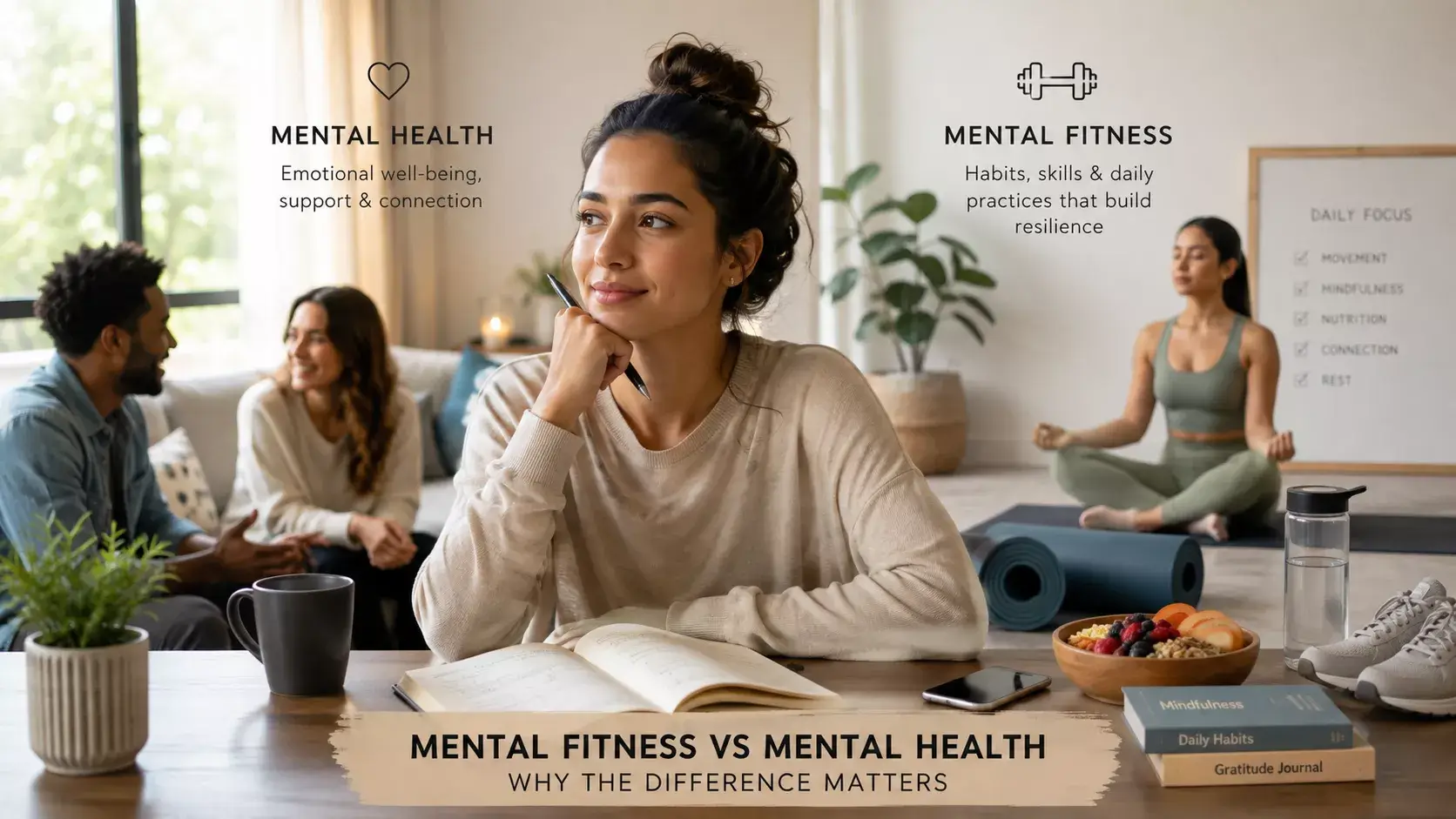
Mental health and mental fitness are closely connected, but they aren't the same thing. Understanding the difference can help you build emotional resilience, manage everyday stress, and take better care of your mind before problems become overwhelming.
We talk about physical fitness all the time. We know that exercising regularly, eating well, sleeping enough, and staying active can help keep our bodies stronger. But when it comes to the mind, the conversation is often less clear.
That's where the idea of mental fitness comes in.
Mental health and mental fitness are related, but they describe different parts of our overall well-being. Mental health is about the state of our psychological and emotional well-being. Mental fitness is more about the skills and habits we can develop to help our minds cope with everyday challenges, adapt to change, and recover from difficult experiences.
Understanding that difference matters because mental well-being isn't only something we should think about when something feels seriously wrong.
Mental Health Is More Than the Absence of a Problem
Mental health is a broad part of overall health. It can influence how we think, feel, behave, relate to other people, handle stress, and make decisions.
Just like physical health, mental health can change over time.
Someone might feel emotionally well for months and then struggle during a stressful period at work, after a relationship ends, while dealing with financial pressure, or during a major life transition. Another person may live with a mental health condition and still have many fulfilling and productive parts of life.
This is important because mental health shouldn't be viewed as a simple "good" or "bad" label.
There is a wide range of experiences between feeling completely well and experiencing a serious mental health condition.
Taking mental health seriously means recognizing changes in mood, sleep, motivation, relationships, concentration, or daily functioning and responding to them rather than simply ignoring them.
So, What Exactly Is Mental Fitness?
Mental fitness is a more proactive idea.
Think of it as exercising the skills that help you navigate life.
Mental fitness can involve learning how to recognize your emotions, manage stress, challenge unhelpful thought patterns, stay connected with people, maintain healthy routines, and recover after setbacks.
It doesn't mean being positive all the time.
In fact, constantly trying to "think positive" can sometimes make difficult emotions harder to acknowledge. Being mentally fit is less about avoiding negative feelings and more about learning how to respond to them in healthier ways.
You can be disappointed without feeling defeated.
You can be nervous without allowing anxiety to make every decision for you.
You can experience failure without deciding that you're a failure.
Those are examples of mental skills that can become stronger with practice.
Mental Fitness Doesn't Replace Mental Health Care
This is one of the most important distinctions.
Mental fitness can support overall well-being, but it isn't a substitute for professional mental health care when someone is experiencing a mental health condition or significant distress.
Going for a walk, practicing mindfulness, getting enough sleep, or talking with a friend can be helpful. But sometimes those things aren't enough — and that's okay.
Just as someone with a physical injury may need a doctor or physiotherapist, someone experiencing significant psychological difficulties may need a qualified mental health professional.
There is no weakness in asking for help.
In fact, recognizing when you need additional support can be an important part of mental fitness itself.
Why Mental Fitness Matters in Everyday Life
Life doesn't have to reach a crisis point before you start caring for your mind.
Everyday habits can influence how well you handle pressure.
For example, imagine you have a difficult day at work. You receive criticism, miss an important deadline, and come home frustrated. Without healthy coping skills, that frustration might turn into hours of overthinking, an argument with someone you care about, or difficulty sleeping.
Mental fitness doesn't make the difficult day disappear.
Instead, it may help you pause and recognize what you're feeling, separate facts from assumptions, decide what actually needs your attention, and give yourself enough space to recover.
That's resilience.
And resilience isn't about never struggling. It's about developing the ability to respond, adapt, and recover.
Simple Ways to Build Mental Fitness
The good news is that mental fitness doesn't require a complicated routine.
Start small.
1. Pay attention to your thoughts
We all have automatic thoughts. Sometimes they're useful; sometimes they're overly negative or unrealistic. Learning to notice them instead of immediately believing every thought can create valuable mental space.
2. Make room for emotions
You don't have to enjoy every emotion to acknowledge it. Saying "I'm disappointed" or "I'm overwhelmed" can be more helpful than pretending everything is fine.
3. Protect your sleep
Sleep affects mood, concentration, energy, and emotional regulation. A consistent sleep routine is one of the simplest foundations for taking care of your mind.
4. Move your body
Physical activity isn't a cure-all, but regular movement can support mood and overall well-being. It can be as simple as walking, stretching, cycling, dancing, or doing a workout you actually enjoy.
5. Stay connected
Humans aren't designed to handle everything alone. A conversation with a trusted friend, family member, colleague, therapist, or support professional can make difficult experiences feel less isolating.
6. Learn to pause
When you're angry, anxious, or overwhelmed, reacting immediately isn't always helpful. A few slow breaths, a short walk, or simply stepping away from the situation can give your brain time to reset before you respond.
7. Know when to ask for help
Persistent changes in mood, sleep, appetite, motivation, concentration, relationships, or daily functioning deserve attention. If something doesn't feel right or is interfering with your life, talking with a qualified professional can be an important next step.
The Bigger Picture
Mental health and mental fitness shouldn't compete with each other.
They work together.
Mental health describes a broader aspect of our well-being, while mental fitness focuses on the habits, skills, and practices that can help us navigate life's challenges.
And perhaps the biggest shift is changing how we think about mental well-being.
We don't wait until our bodies are seriously unwell before we start caring about physical fitness. We can take the same preventive approach to our minds.
You don't need to be in crisis to care about your mental health.
You don't need to have everything figured out to build resilience.
And you certainly don't need to handle every difficult moment alone.
Mental fitness is ultimately about giving yourself tools for the moments when life gets complicated. Some days those tools may be enough to help you reset after a stressful morning. Other days, they may help you recognize that you need more support.
Both are valuable.
The goal isn't to create a mind that never struggles. That's unrealistic.
The goal is to develop a healthier relationship with your thoughts, emotions, challenges, and yourself — while knowing when professional support is needed.
That is why understanding the difference between mental fitness and mental health matters.




Post a comment