

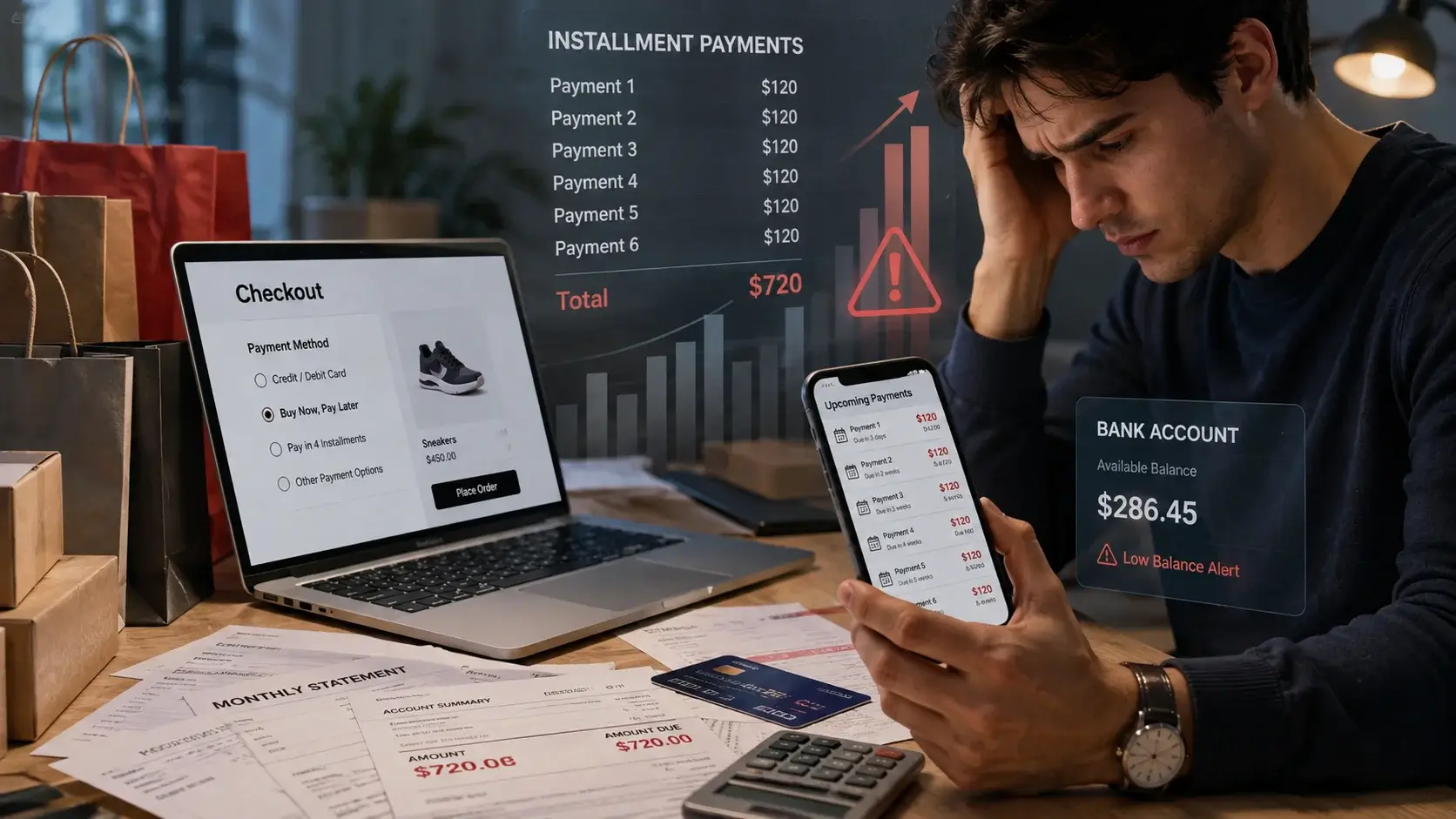
Buy Now, Pay Later can make expensive purchases feel affordable, but the real cost may show up later through late fees, overdrafts, multiple payments, returns, and debt stacking. Here’s what shoppers should know before choosing BNPL at checkout.
Walk into an online store today, add a pair of shoes, a smartphone, a television, or even a vacation package to your cart, and there’s a good chance you’ll see one tempting option at checkout: “Buy Now, Pay Later.”
The pitch sounds simple. Pay a small amount today, split the rest into a few installments, and take your purchase home immediately.
For someone who is trying to manage a tight monthly budget, that can sound like a smart solution. And sometimes, it can be. Many BNPL plans advertise little or no interest, and some allow shoppers to divide a purchase into four payments spread over several weeks.
But there’s a catch that is easy to overlook.
The biggest cost of Buy Now, Pay Later may not be the interest rate. It can be the way the payment system changes how you spend money.
Instead of asking, “Can I afford this $400 purchase?” shoppers may start asking, “Can I afford $100 today?”
That small psychological difference can have a surprisingly big impact on a household budget.
What Exactly Is Buy Now, Pay Later?
Buy Now, Pay Later, commonly called BNPL, is a form of short-term installment credit. A typical plan allows you to make a purchase immediately and repay it through several installments.
A common “pay-in-four” structure divides the purchase into four payments, with one payment often due at checkout and the remaining payments scheduled over the following weeks. The CFPB describes BNPL as an installment loan and notes that many plans are offered with little or no initial payment.
The appeal is obvious.
You don't have to wait until payday. You don't necessarily need a traditional credit card. And the payment at checkout can look much smaller than the actual price of the product.
That convenience is exactly why BNPL has become such a familiar option for online shoppers.
But convenience and affordability are not the same thing.
The Hidden Cost: Small Payments Can Encourage Bigger Spending
Imagine you want to buy a $600 television.
Paying $600 today might make you stop and think. But seeing an option such as four payments of $150 can make the purchase feel much easier.
Now imagine doing the same thing with a $200 pair of shoes, a $300 phone accessory bundle, and a $150 piece of furniture.
Each purchase may appear manageable on its own.
The problem begins when the payments overlap.
You may suddenly have several automatic payments coming out of your account every week or every two weeks. None of the individual payments looks particularly frightening, but together they can consume a significant portion of your disposable income.
This is sometimes called debt stacking — taking on multiple short-term obligations at the same time.
A 2025 CFPB study examined BNPL usage alongside other unsecured debt and highlighted the difficulty of measuring how consumers stack BNPL loans across different providers.
“Interest-Free” Doesn't Always Mean Cost-Free
One of the most attractive BNPL features is the promise of zero interest.
But zero interest doesn't necessarily mean zero cost.
Depending on the provider and plan, consumers may face late fees, payment-related fees, or other charges. The CFPB says that while many BNPL loans don't charge interest, most charge late fees when payments aren't made on time.
There's another possible cost that shoppers sometimes forget: bank fees.
Suppose your BNPL payment is automatically withdrawn from your bank account, but your account doesn't have enough money available that day.
The BNPL provider may attempt to collect the payment, and your bank could potentially charge an overdraft or insufficient-funds fee depending on your account and circumstances.
Suddenly, the “free” installment plan isn't quite as free.
Autopay Can Be Convenient — Until Your Balance Is Low
Automatic payments are designed to make BNPL easy.
You don't have to remember every due date. The payment simply comes out automatically.
But there's a downside.
If several BNPL purchases have overlapping payment schedules, money can leave your bank account without you actively thinking about each transaction.
This can create a dangerous situation: you may believe you have $500 available to spend, while several upcoming automatic payments are already scheduled to take $200 or $300.
The money is technically in your account, but it isn't really available for discretionary spending.
That's why it's important to treat future BNPL payments as existing financial obligations — not as future problems.
Missing One Payment Can Create More Problems
A missed BNPL payment doesn't automatically mean your finances are ruined. But ignoring it can make the situation worse.
Depending on the provider's terms, you could face a late fee, lose access to future BNPL purchases, or eventually have the debt sent to a collection agency. The CFPB warns that unpaid BNPL debt can potentially be reported to credit reporting companies if it reaches a debt collector.
Credit reporting is another area where consumers need to pay attention.
Many traditional pay-in-four BNPL products historically haven't reported regular payment activity to major credit bureaus. However, BNPL products and providers can differ, and some installment products may involve credit checks or credit reporting.
In other words, don't assume that every BNPL purchase will have the same effect on your credit profile.
Read the terms.
Returns Can Be More Complicated Than You Expect
Here's another issue that doesn't get much attention when you're standing at the checkout page: what happens when you return the product?
If you purchase something with BNPL and later decide you don't want it, the store's return process and the BNPL provider's payment process may not always move at exactly the same speed.
You might still see a payment scheduled while your return or refund is being processed.
The FTC recommends understanding the return and payment rules before using a BNPL plan. It also warns that consumers may not always receive back money they've already paid immediately after returning an item.
That doesn't mean BNPL purchases cannot be returned. It means shoppers should understand who handles the refund, when payments stop, and what happens to installments that are already scheduled.
The Psychological Cost May Be the Biggest One
This is arguably the hidden cost that deserves more attention.
BNPL can reduce the “pain of paying.”
Paying $1,000 for something feels very different from paying $250 four times.
The total price hasn't changed.
But the mental experience has.
When the payment is broken into small pieces, expensive products can feel more affordable than they really are. That can make impulse purchases easier.
A person who wouldn't normally spend $800 on a new device might convince themselves that $200 today is manageable.
Then another purchase comes along.
And another.
Before long, the problem isn't one large purchase. It's a collection of small payments.
So, Is Buy Now, Pay Later Bad?
Not necessarily.
BNPL can be useful when it's used carefully and for purchases you can genuinely afford.
For example, if you already have the full amount saved but prefer to spread payments for cash-flow reasons, a genuinely low-cost BNPL plan may be reasonable.
The problem starts when BNPL becomes a way to purchase something you couldn't otherwise afford.
That's an important distinction:
Using BNPL to manage cash flow is different from using BNPL to create spending power.
If you don't have enough money to comfortably cover the purchase, splitting the payment doesn't make the purchase cheaper.
It simply creates a new obligation.
Five Questions to Ask Before Clicking “Pay Later”
Before using BNPL, take a minute and ask yourself:
1. Could I afford the full price today?
If the answer is no, ask why you need the purchase right now.
2. What happens if I miss a payment?
Check late fees, account restrictions, and collection policies.
3. How many other installment payments do I already have?
Look at your upcoming bank transactions, not just today's balance.
4. What happens if I return the product?
Understand both the retailer's refund policy and the BNPL provider's process.
5. Am I buying this because I need it — or because the payment looks small?
This may be the most important question of all.
The Bottom Line
Buy Now, Pay Later isn't automatically a financial trap. It's a financial product.
And like any financial product, it works best when you understand exactly what you're agreeing to.
The biggest mistake is focusing only on the amount due today.
Instead, look at the total purchase price, every scheduled payment, possible fees, your other debts, and your ability to handle the payments if something unexpected happens.
The checkout button may say “Pay Later,” but your financial obligations don't disappear. They simply move into the future.
And sometimes, that future bill arrives faster than you expect.
Before you click “Buy Now, Pay Later,” make sure you're not simply turning today's impulse into tomorrow's budget problem.
This article is for general educational purposes and is not personalized financial advice. BNPL terms, fees, credit reporting practices, and consumer protections can vary by provider and location. Always read the specific terms before accepting a BNPL plan.

Post a comment