

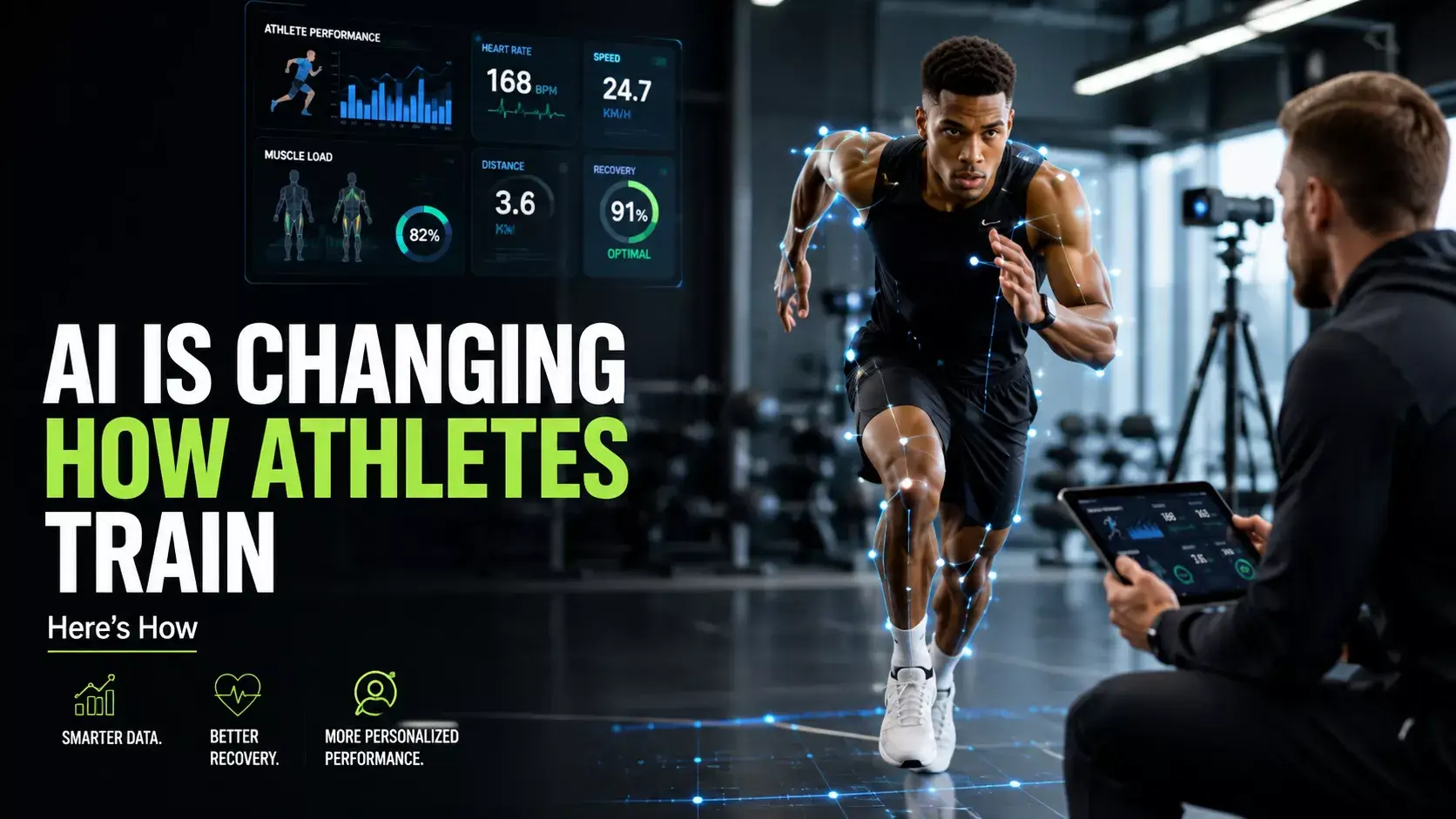
Artificial intelligence is transforming sports training by helping athletes analyze performance, personalize workouts, prevent injuries, improve recovery, and make smarter decisions. Here’s how AI is changing the way modern athletes prepare to compete.
For years, athletic training followed a familiar formula: work harder, train longer, study game footage, follow a nutrition plan, and trust the experience of coaches. That formula still matters, but technology is changing how athletes understand their bodies and improve their performance.
Artificial intelligence is becoming one of the biggest new tools in modern sports.
From professional football and basketball to running, cycling, tennis and other competitive sports, athletes are increasingly using AI-powered technology to turn enormous amounts of performance data into useful information. Instead of simply knowing how fast an athlete ran or how many shots they took, coaches and athletes can now look deeper into movement, workload, recovery, technique and patterns that may not be obvious to the human eye.
The interesting part is that AI isn't replacing coaches or athletes. Instead, it is becoming another layer of information that can help them make better decisions.
Training Is Becoming More Personalized
One of the biggest advantages of AI is personalization.
Two athletes can complete the same workout but respond to it very differently. One might recover quickly, while another could need more rest. One athlete may perform better with high-intensity sessions, while another may benefit from a different training balance.
AI systems can analyze information such as training history, performance data, workload, sleep patterns, heart-rate information and recovery metrics. From there, coaches can use those insights to adjust training programs.
That means an athlete's training plan doesn't necessarily have to remain the same every week.
If the data suggests an athlete is fatigued, the next session may be reduced. If performance is improving and recovery looks strong, training intensity may increase.
The goal isn't simply to train harder. It's to train smarter.
AI Can Help Athletes Understand Performance
Modern athletes generate huge amounts of data.
Cameras can track movement. Wearable devices can record heart rate and activity. GPS systems can measure distance and speed. Video systems can analyze technique and positioning.
The challenge has always been turning all of that information into something useful.
That's where AI becomes powerful.
Instead of asking a coach to manually review thousands of pieces of data, AI can identify patterns and highlight areas that deserve attention.
For example, a soccer player might discover that their sprint performance drops after a certain workload. A basketball player could analyze shooting patterns from different areas of the court. A runner might identify changes in stride or running efficiency when fatigue begins to appear.
These insights can give athletes a much clearer picture of what is actually happening during training.
Injury Prevention Is Another Major Area
Perhaps one of the most exciting applications of AI in sports is injury prevention.
No technology can guarantee that an athlete will avoid injury. Sports are unpredictable, and injuries can happen even when training is carefully managed.
However, AI can help identify warning signs.
By analyzing workload, movement patterns, recovery data and historical information, AI systems may identify situations where an athlete's physical load is becoming unusually high or their movement is changing.
Imagine a player who normally moves in a certain way but gradually begins compensating because of fatigue. A human coach might notice it, but AI-assisted video or sensor analysis could potentially identify subtle changes much earlier.
That information can lead to a simple but important decision: reduce the workload, change the exercise or give the athlete additional recovery time.
Sometimes, smarter training means knowing when not to train harder.
Recovery Is Becoming Data-Driven
Training is only half of athletic performance. Recovery matters just as much.
Sleep, nutrition, hydration, rest and workload all influence how an athlete performs the next day.
AI-powered systems can combine recovery information from multiple sources and help athletes understand whether their bodies are ready for another demanding session.
For example, an athlete may feel mentally ready to train but show signs of physical fatigue through other measurements. Another athlete might recover better than expected and be ready for a more challenging workout.
This doesn't mean athletes should blindly follow an app's recommendation. Instead, the data gives coaches another piece of the puzzle.
The best approach combines technology with human judgment.
AI Is Changing Game Preparation Too
AI isn't limited to the gym or training field.
It is also changing how athletes prepare for competition.
Teams can use advanced analytics to study opponents, identify tendencies and understand game situations. Coaches can examine patterns that would be difficult to recognize through traditional video analysis alone.
For athletes, this can translate into more targeted preparation.
A tennis player may study an opponent's serving patterns. A basketball team can analyze shot selection. A football player can review defensive tendencies.
The result is a more detailed understanding of the competition before the game even begins.
Instead of simply watching hours of footage, athletes and coaches can use technology to focus on the moments and patterns that matter most.
Mental Performance Could Benefit Too
Physical performance gets most of the attention in sports, but the mental side of competition is equally important.
AI-powered tools are increasingly being explored for areas such as focus, routine tracking, performance analysis and personalized feedback.
For example, athletes can use data to identify when their performance changes under pressure or during different competition situations.
That doesn't mean AI can replace a sports psychologist or coach. Human emotions are far too complicated for a simple algorithm.
But technology can help athletes recognize patterns and start conversations about areas that need improvement.
The Human Coach Still Matters
With all this talk about artificial intelligence, it's easy to imagine a future where algorithms make every training decision.
That's unlikely to be the best model.
Sports are deeply human. Motivation, confidence, personality, team chemistry and life circumstances cannot always be reduced to numbers.
A coach understands the athlete as a person.
AI can say that an athlete's workload increased. A coach can understand why.
AI can identify a change in performance. A coach can talk to the athlete and determine whether the issue is physical fatigue, stress, confidence or something completely different.
That's why the strongest future for sports training is probably not AI versus coaches.
It's AI plus coaches.
Technology provides information. Humans provide context.
Are There Downsides?
AI in sports also comes with challenges.
Privacy is an important concern because wearable devices and performance systems can collect highly personal information. Teams and organizations need to think carefully about who owns that data, who can access it and how it is used.
There is also the risk of relying too heavily on numbers.
Not everything valuable in sports can be measured.
An athlete can have excellent statistics and still be struggling mentally. A player can have an unusual training day and still perform brilliantly in competition.
AI should support decision-making rather than completely control it.
There is also the issue of access. Elite professional teams may have sophisticated technology, analysts and large datasets, while amateur athletes may not have the same resources.
Over time, however, many AI-powered tools are likely to become more accessible to everyday athletes.
The Future of Athletic Training
The biggest change AI brings to sports may not be one revolutionary invention.
It may simply be the ability to make better decisions more consistently.
Athletes are gaining access to information that previous generations could only dream about. Instead of relying entirely on intuition, they can combine experience with data.
Training can become more personalized. Recovery can become more carefully managed. Performance analysis can become faster. Injury risks can potentially be identified earlier. Competition preparation can become more detailed.
But the fundamentals aren't disappearing.
Athletes still need discipline. They still need quality coaching. They still need sleep, nutrition, practice and mental strength.
AI is simply adding another tool to the toolbox.
The athletes who benefit most may not be the ones who use the most technology. They may be the ones who understand how to use the right technology at the right time.
That is what makes AI's role in sports so interesting.
The future of athletic training isn't necessarily about replacing traditional coaching. It's about combining human experience with intelligent technology to help athletes understand themselves better and perform at their best.
And as AI continues to improve, the line between training smarter and training harder may become clearer than ever: the goal isn't more work. It's better work.

Post a comment